
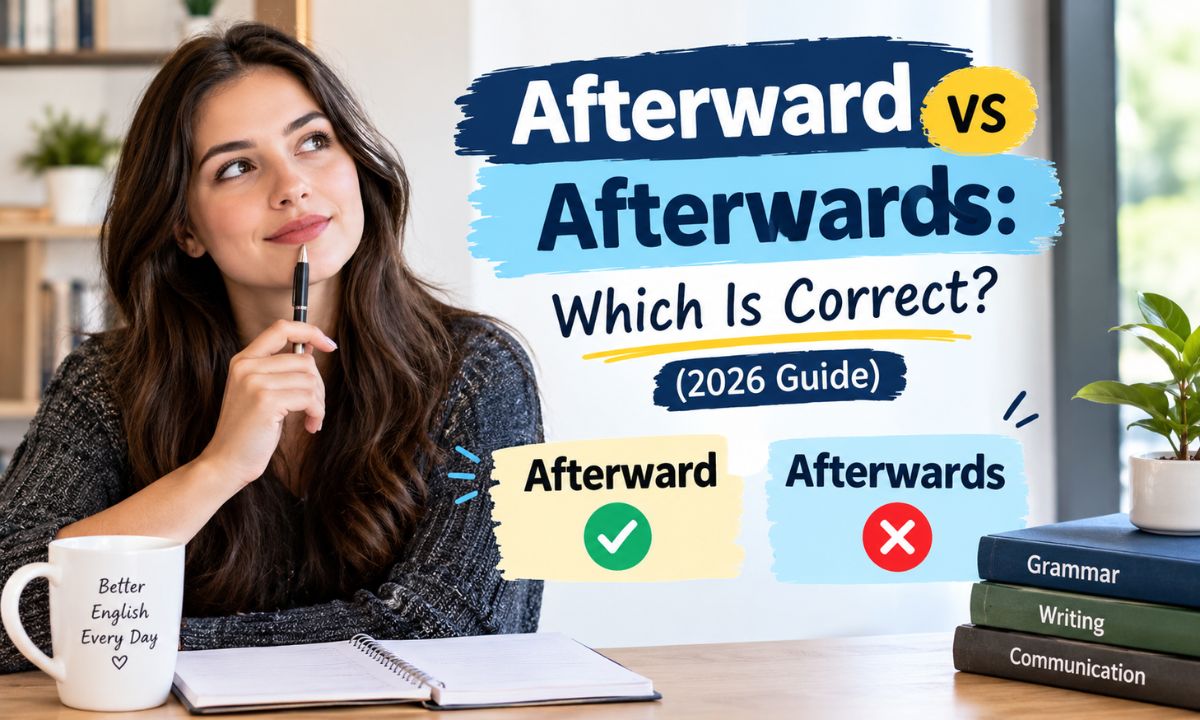
You are typing an email. You want to say something happened later. Then you stop. Should it be “afterward” or “afterwards”? Many people pause at this exact spot.
You are not alone. Both words look right. Both sound right. And both show up in books, news stories, and daily chats. So which one should you pick?
This guide gives you a clear answer. You will learn what each word means, how Americans use them, and how to pick the right one every time. You will also find examples, a quiz, practice exercises, and quick memory tricks.
Quick Answer
Both words are correct. They mean the same thing. They both mean “at a later time” or “after something else happened.”
The only real difference is style and region. In the United States, afterward is the more common and preferred form. In the United Kingdom and other English-speaking countries, afterwards is more common.
If you write for a US audience, use afterward. If you write for a UK audience, use afterwards. If you are unsure, pick one and stay consistent through the whole piece.
Here is a quick example:
- US style: We ate dinner and went for a walk afterward.
- UK style: We ate dinner and went for a walk afterwards.
Both sentences are grammatically correct. Only the style changes.
Quick Overview Table
This table gives you the main facts at a glance. Save it or screenshot it for later.
| Feature | Afterward | Afterwards |
| Part of speech | Adverb | Adverb |
| Meaning | At a later time | At a later time |
| Correct in English? | Yes | Yes |
| Preferred in the US | Yes | Less common |
| Preferred in the UK | Less common | Yes |
| Pronunciation | AF-ter-werd | AF-ter-werdz |
| Formal writing (US) | Best choice | Acceptable, but less typical |
| Casual writing (US) | Common | Also common in speech |
| Can I start a sentence? | Yes | Yes |
| Can I end a sentence? | Yes | Yes |
As you can see, the two words are nearly twins. The “s” at the end is the only visible gap.
What Does “Afterward” Mean?

“Afterward” is an adverb. It tells you when something happens. It means “later” or “after a certain event or time.”
You use it when one thing follows another. For example, you might finish a meeting and talk with a friend afterward. The word points back to something already mentioned. It does not need a second word to complete it.
In American English, this is the standard spelling. You will find it in newspapers, school books, business emails, and legal papers across the US.
Afterward vs afterwards meaning
The meaning of both words is the same. Both describe time that comes after an event. There is no hidden shade of meaning. One does not feel more polite, more formal, or more correct in a grammar sense.
The difference is habit. Writers in different regions grew up with different forms. Over time, each region kept its favorite. That is all.
Think of it like “color” and “colour.” The word is the same. The spelling follows local custom.
Afterward or afterwards synonym
Several words can replace either form. Which one fits depends on the sentence. Here are the most common choices:
- Later
- Subsequently
- Next
- Then
- Following that
- After that
- Thereafter
- Later on
For example, “We watched the game and had pizza afterward” can become “We watched the game and had pizza later.” The meaning stays close.
Afterward meaning
At its core, “afterward” means “at a later time.” It answers the question, “When?” It usually links to an event you have already named.
Here are a few simple ways to see it:
- After class, I will study. Afterward, I will cook dinner.
- She finished her workout. Afterward, she took a shower.
- The movie ended. We talked about it afterward.
In each case, the word points to the time that comes next.
Afterward vs afterwards worksheet
A short worksheet can help you lock in the idea. Try filling in each blank with the form you would use in the US. Answers are below.
Worksheet: Fill in the blank
- We finished the project and went out for lunch ________.
- The doctor checked my knee. ________, I felt much better.
- They cleaned the kitchen and relaxed ________.
- Let’s see the show first. We can eat ________.
- He said sorry ________, but it was too late.
Answers (US style):
- afterward
- Afterward
- afterward
- afterward
- afterward
If you are writing for a UK reader, swap in “afterwards” for each blank.
Afterward vs afterwards quiz
Test yourself with this quick quiz. Choose the best answer.
Question 1. Which word is more common in American English?
- A) Afterwards
- B) Afterward
Question 2. Do the two words have different meanings?
- A) Yes, a big difference
- B) No, the meaning is the same
Question 3. Which sentence is correct?
- A) I will call you afterward.
- B) I will call you afterwardz.
Question 4. Which region more often uses “afterwards”?
- A) The United Kingdom
- B) The United States
Question 5. Is “afterwards” an error in the US?
- A) Yes, always
- B) No, but “afterward” is more common
Quiz answers: 1-B, 2-B, 3-A, 4-A, 5-B.
Afterward in a sentence
Seeing the word in real sentences makes it easier to remember. Here are clear examples:
- We cleaned up the yard, and afterward we ordered tacos.
- Call me afterward so I know you got home safe.
- She felt nervous before the test but relieved afterward.
- Afterward, the team gathered to talk about the game.
- He took a short nap afterward.
Notice how the word fits at the start, middle, or end of a sentence. It works in all three spots.
Read More: IDM Meaning in Text
Afterward vs afterwards example
Here are matching sentences. The first uses the US form. The second uses the UK form.
| American English | British English |
| We went to the park, and afterward we got ice cream. | We went to the park, and afterwards we got ice cream. |
| Afterward, she sent a thank-you note. | Afterwards, she sent a thank-you note. |
| I will explain it afterward. | I will explain it afterwards. |
| They felt tired afterward. | They felt tired afterwards. |
The meaning does not change in any pair.
Afterward vs afterwards exercises
Now try a few practice exercises. These will help you build a steady habit.
Exercise 1: Pick one form and stay consistent. Rewrite the paragraph below for a US reader.
“We had coffee. Afterwards, we walked home. We talked about work afterwards, too.”
Answer: “We had coffee. Afterward, we walked home. We talked about work afterward, too.”
Exercise 2: Rewrite with a synonym. Replace “afterward” with another word.
“I washed the dishes and afterward I watched TV.”
Possible answer: “I washed the dishes and then I watched TV.”
Exercise 3: Place the word in different spots. Write three sentences with “afterward” at the start, middle, and end.
Possible answers:
- Afterward, we went home.
- We went afterward to the store.
- We went to the store afterward.
Common Uses of “Afterward”
People use “afterward” in many daily situations. It shows up in plans, stories, advice, and reports. It is a handy tool when you want to show order without adding extra words.
The word often appears with events. You will see it after meals, games, meetings, trips, and big life moments. It also pairs well with words like “soon,” “shortly,” and “not long.”
Here are the most common ways to use it:
- To show the next step: Mix the dough. Let it rest afterward.
- To describe feelings after an event: I felt proud afterward.
- To plan a later action: Let’s talk afterward.
- To tell a story in order: Afterward, everything changed.
- To give advice: Stretch before running, and drink water afterward.
Examples:
- After the concert, we grabbed a late snack. Afterward, we took a cab home.
- I will finish my report. Afterward, I will send it to my boss.
- The storm passed quickly. Afterward, the air felt fresh.
- She studied for two hours and rewarded herself afterward.
- We said our goodbyes. Afterward, the house felt quiet.
What Does “Afterwards” Mean?

“Afterwards” is also an adverb. It also means “at a later time” or “after an event.” There is no change in meaning at all.
The extra “s” is the only change. It is the form most common in British English. You will see it in UK newspapers, novels, and websites. It is also common in Australia, Ireland, and other places that follow British style.
In the US, you may still hear “afterwards” in speech. Many Americans say it without thinking. In writing, though, “afterward” is the safer pick for a US audience.
Common Uses of “Afterwards”
“Afterwards” works in the same spots as “afterward.” It can show order, timing, or a result. It can sit at the start, middle, or end of a sentence.
Here are typical ways people use it:
- To list steps in order: Peel the apples. Afterwards, slice them.
- To talk about plans: We can meet for coffee afterwards.
- To describe the result: Afterwards, he felt much better.
- In storytelling: Afterwards, nobody spoke about it again.
- In casual talk: See you afterwards!
Examples:
- We watched the match and went to the pub afterwards.
- She apologized afterwards, but the damage was done.
- Let’s finish the lesson. Afterwards, we can have a break.
- He felt a bit dizzy afterwards.
- Afterwards, the whole class clapped.
Afterward vs. Afterwards: Key Differences
The key differences are small. They come down to region, style, and habit. They do not change grammar or meaning.
Here is a clear side-by-side look:
| Point | Afterward | Afterwards |
| Meaning | At a later time | At a later time |
| Grammar role | Adverb | Adverb |
| Main region | United States | United Kingdom and others |
| US writing choice | Preferred | Acceptable |
| UK writing choice | Less common | Preferred |
| Ending sound | -werd | -werdz |
| Feels formal? | Neutral | Neutral |
Some people think “afterwards” sounds softer or more casual. Others think “afterward” sounds crisp and formal. These feelings come from habit, not rules.
The best rule is simple. Match your audience. Then stay consistent. Do not mix both forms in one article, email, or paper. Mixing looks careless.
Easy Way to Remember the Difference Between Afterward and Afterwards
Here is a simple trick. Think of the letter “s” as standing for “Stay across the pond.” If the word has the extra “s,” picture it traveling to the UK. If it has no “s,” picture it staying home in the US.
Another trick: “Afterward” has no extra baggage. The American form is shorter and cleaner. The British form carries the extra “s.”
You can also link the words to places:
- No S = USA (afterward)
- S = Britain’s style (afterwards)
It is not a perfect rule for every writer. But it works well for most everyday choices.
Examples:
- US email: “Let’s meet at noon and grab lunch afterward.”
- UK email: “Let’s meet at noon and grab lunch afterwards.”
- US blog post: “Bake the cake for 30 minutes. Cool it afterward.”
- UK blog post: “Bake the cake for 30 minutes. Cool it afterwards.”
How to Use Afterward and Afterwards in Sentences
Both words follow the same rules. They are adverbs, so they describe when an action happens. They do not need an object. They do not connect two clauses by themselves. That means you often need a comma, a period, or a conjunction nearby.
You can place the word in three main spots:
- At the start: Afterward, we went home.
- In the middle: We went afterward to a cafe.
- At the end: We went to a cafe afterward.
The start of a sentence usually takes a comma. The end of a sentence usually does not need one. The middle position is rarer, but it still works.
A common mistake is to treat the word like “after.” They are close, but they do not work the same way. “After” needs something to follow it, such as “after lunch.” “Afterward” stands alone.
- Correct: We had lunch. Afterward, we left.
- Correct: After lunch, we left.
- Not correct: We had lunch. After, we left. (This sounds unfinished in formal writing.)
Examples with “Afterward”
- We finished the hike and rested afterward.
- Afterward, the kids fell asleep in the car.
- He called his mom afterward to share the news.
- You can ask questions afterward.
- I felt a little sore afterward.
- The coach gave a short speech afterward.
Examples with “Afterwards”
- We finished the hike and rested afterwards.
- Afterwards, the kids fell asleep in the car.
- He rang his mum afterwards to share the news.
- You can ask questions afterwards.
- I felt a little sore afterwards.
- The coach gave a short speech afterwards.
Common Situations Where Afterward and Afterwards Are Used
You will find these words in many parts of life. They help show order without sounding stiff. Cooking, school, work, health, sports, and travel all use them often.
Think about how often you explain a plan. You say what happens first. Then you say what happens next. “Afterward” is a quick bridge between those two parts.
The words also help you share feelings. People say they felt happy, tired, or relieved afterward. This ties emotions to a moment in time.
Everyday Uses:
- Cooking: Boil the pasta. Drain it afterward.
- Work: Finish the call. Send a summary afterward.
- School: Take the test. Review your answers afterward.
- Health: Do your workout. Stretch afterward.
- Travel: Land in the city. Rest a bit afterward.
- Social plans: Grab dinner first. Catch a movie afterward.
- Safety: Wash your hands afterward.
- Feelings: I felt calmer afterward.
Afterward vs. Afterwards in American and British English
This is where the real split shows up. American English leans toward “afterward.” British English leans toward “afterwards.” Neither side treats the other form as wrong.
Many American style guides and dictionaries list “afterward” as the main form. They list “afterwards” as a common variant. British sources often do the opposite. Because of this, you will see the choice change with the publication.
Other words follow a similar pattern. Think of “toward” and “towards,” or “backward” and “backwards.” American English tends to drop the final “s.” British English tends to keep it. Once you notice this habit, the choice becomes easier.
For a US audience, here is a safe approach. Use “afterward” in blogs, emails, reports, essays, and business writing. Use “afterwards” only if you quote someone, follow a UK brand, or write a character who speaks that way.
Examples:
| Situation | Best form for the US | Best form for the UK |
| Business email | afterward | afterwards |
| School essay | afterward | afterwards |
| Blog post | afterward | afterwards |
| News article | afterward | afterwards |
| Quoting a British speaker | keep “afterwards” | afterwards |
Related pairs follow the same pattern:
- toward / towards
- backward / backwards
- forward / forwards
- upward / upwards
Pronunciation of Afterward and Afterwards
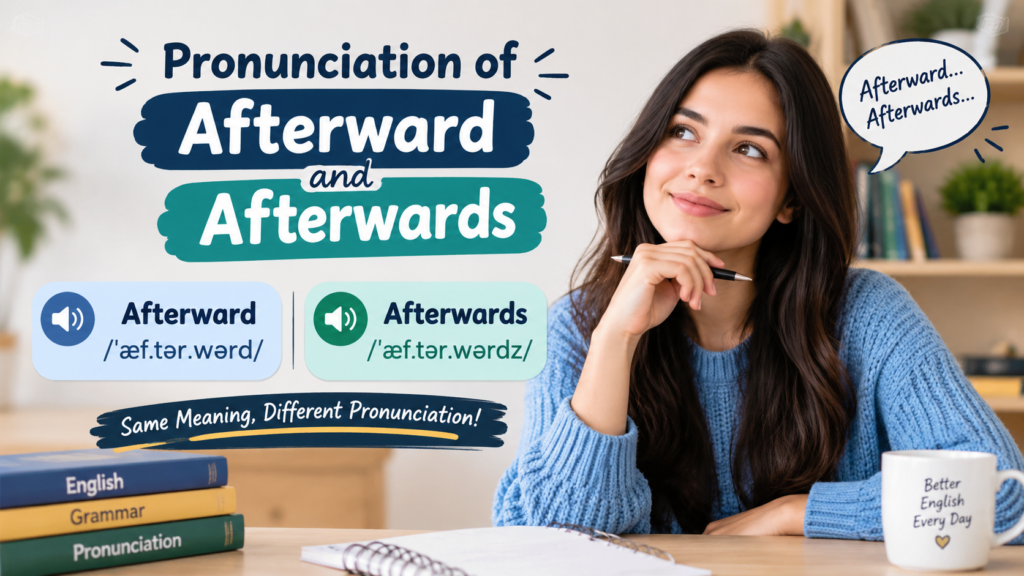
Both words start with the same sounds. The stress falls on the first syllable. That is “AF,” as in “after.”
Here is how to say each one:
- Afterward: AF-ter-werd
- Afterwards: AF-ter-werdz
The only change is a soft “z” sound at the end of “afterwards.” That sound is short. It is easy to miss fast speech.
Many Americans say “afterwards” out loud without noticing. This is normal. Speech is looser than writing. So you can hear “afterwards” in a US movie, and still see “afterward” in a US book.
If you are giving a talk, pick whichever sounds natural. If you are writing the script, follow your style choice. Keep it steady.
Examples:
- “We can talk afterward.” Say it as: wee kan tawk AF-ter-werd.
- “We can talk afterwards.” Say it as: wee kan tawk AF-ter-werdz.
- “Let’s eat first, and shop afterward.” Say it as: AF-ter-werd.
- “She called me afterwards.” Say it as: AF-ter-werdz.
Afterward vs. Afterwards in Formal and Informal Writing
Neither word is more formal than the other in terms of grammar. Both can appear in a legal letter or in a text to a friend. What shifts the feel is the setting and the region.
In formal US writing, “afterward” is the better fit. Think of reports, academic papers, press releases, and professional emails. It matches common style guides and looks clean on the page.
In informal writing, you have more freedom. Americans often type “afterwards” in texts or social posts without any issue. It looks natural in a chat. Still, if you want your content to feel polished, stick with “afterward.”
A quick guide:
- Formal US writing: afterward
- Informal US writing: afterward or afterwards
- Formal UK writing: afterwards
- Informal UK writing: afterwards
Examples:
- Formal: “The committee will review the proposal, and afterward it will issue a decision.”
- Informal: “Let’s grab food afterward!”
- Formal UK: “The panel will meet, and afterwards it will release a statement.”
- Informal UK: “Pop round afterwards, yeah?”
Afterward or Afterwards in Storytelling and Narratives
Writers often use these words to move a story forward. They mark time without slowing the pace. One short word can jump the reader from one scene to the next.
In fiction, the choice can also shape the voice. An American novel will likely say “afterward.” A British novel will likely say “afterwards.” If your story has a British narrator, “afterwards” helps the voice feel real.
Be careful not to overuse the word. If every paragraph starts with “Afterward,” the story can sound flat. Mix it up. Use “later,” “soon after,” or “then” for variety. Also, vary where you place the word in the sentence.
Examples:
- She closed the door. Afterward, the house felt strangely quiet.
- Nobody spoke about the fire afterward.
- He won the race, and afterward he cried in the locker room.
- Afterwards, the villagers whispered about the stranger. (British voice)
- The detective found the key and, afterward, the truth.
Synonyms of Afterward and Afterwards
Synonyms help your writing stay fresh. They also help you avoid repeating the same word again and again. But no synonym is a perfect match. Each one carries a slightly different feel.
Some synonyms are casual. Some are formal. Some are best at the start of a sentence. Others work better in the middle. Pick the one that fits the tone of your piece.
Common Synonyms:
| Synonym | Tone | Best use |
| Later | Neutral | Everyday writing |
| Then | Casual | Steps and stories |
| Next | Casual | Instructions |
| After that | Neutral | Plans and tasks |
| Subsequently | Formal | Reports and papers |
| Thereafter | Very formal | Legal or official text |
| Following that | Formal | Business writing |
| Later on | Casual | Conversation |
| Eventually | Neutral | Long gaps in time |
Examples:
- We ate dinner. Later, we watched a film.
- Mix the flour and eggs. Then add the milk.
- The board approved the plan. Subsequently, the team began work.
- She finished her exam. After that, she went out with friends.
- He moved to Texas in 2020 and thereafter opened a small shop.
A small note: “eventually” often implies a long wait. “Afterward” does not. So do not swap them without thinking.
Afterward vs. Afterwards in American and British Publications
Publications often follow a house style. This is a written set of rules that keeps spelling and grammar consistent. It is why you see the same form across a whole newspaper or magazine.
Most US publications follow American style guides. Those guides lean toward “afterward.” Most UK publications follow British guides. Those lean toward “afterwards.” That is why the split looks so neat in print.
If you write for a website or a client, ask for their style guide. If they do not have one, use the form that matches your target audience. For a US audience, that means “afterward.”
Examples:
| Publication type | Likely form |
| US newspaper | afterward |
| US magazine | afterward |
| US academic journal | afterward |
| UK newspaper | afterwards |
| UK magazine | afterwards |
| UK novel | afterwards |
| International site with US readers | afterward |
Here is a simple check you can use:
- Who is my reader?
- Where do they live?
- Does my client have a style guide?
- Am I staying consistent in the whole piece?
If you can answer these four questions, you can pick the right form in seconds.
Tips to Remember the Difference Between Afterward and Afterwards
Memory tips make the choice fast. You do not need to look up the word each time. A few small habits are enough.
Try linking the word to a clear picture. Imagine a US flag and a short word. Then imagine a British tea cup and a longer word. This gives your brain a simple map to follow.
You can also build a habit around your audience. Before you write, name your reader. Then choose the form once. After that, use find and replace to check the whole page.
Easy Memory Tips:
- No “s” for the USA. Afterward is the American pick.
- Add “s” for the UK. Afterwards is the British pick.
- Short and clean. American English often drops the final “s.”
- Match the pair. If you write “toward,” write “afterward.”
- Pick once, stay steady. Do not switch mid-article.
- Use a style guide. It settles the debate fast.
- Read it aloud. Your ear can catch odd mixing.
Examples:
- Match the pair (US): “We walked toward the park and talked afterward.”
- Match the pair (UK): “We walked towards the park and talked afterwards.”
- Mixed (avoid): “We walked toward the park and talked afterwards.”
The mixed example is not an error. But it looks uneven. Stay in one lane.
Afterward and Afterwards in Digital Communication and Social Media
Online, rules loosen up. People type fast. They use short words, emojis, and slang. In that world, both forms appear, and few people notice or care.
Still, your goal matters. If you run a brand page, a blog, or a business profile, polish counts. A steady style helps readers trust you. For a US audience, “afterward” gives a clean, professional look.
In texts and chats, you can use either one. Autocorrect may even pick for you. Just watch out for typos like “afterwars” or “after ward.” These look sloppy, and they happen a lot.
Examples:
- Tweet: “Best pizza ever. Coffee afterward? ☕”
- Instagram caption: “Sunset hike first, tacos afterward.”
- Text message: “Call me afterwards, ok?”
- LinkedIn post: “I attended the webinar and shared my notes afterward.”
- Email subject: “Quick chat afterward?”
A few digital writing tips:
- Keep posts short.
- Use one form across your brand.
- Proofread before you hit send.
- Do not write “after ward” as two words.
Common Mistakes When Using Afterward and Afterwards
Most mistakes are small. They do not break the meaning. But they can make your writing look rushed. Here are the usual slip-ups.
The first mistake is thinking one word is wrong. Neither is wrong. People sometimes “correct” a perfectly fine form. That can lead to a bad edit.
The second mistake is mixing forms in one piece. This can confuse readers about your style. The third is splitting the word into two parts. “Afterward” is not a word. And the fourth is confusing “afterward” with “afterword,” which has a very different meaning.
Examples:
| Mistake | Wrong | Right |
| Splitting the word | We left afterwards. | We left afterward. |
| Wrong spelling | We left afterward. | We left afterward. |
| Mixing forms | Afterward, we ate. Afterwards, we slept. | Afterward, we ate. Afterward, we slept. |
| Confusing with “afterword” | I read the book. | I read the afterword of the book. |
| Using “after” alone | We ate. After, we left. | We ate. Afterward, we left. |
Here is a note on “afterword.” An afterword is a short section at the end of a book. It is a noun. “Afterward” is an adverb. They sound the same, but they are not the same word.
Afterward and Afterwards in Academic and Professional Writing
In school and at work, clarity matters most. You want your reader to follow your steps with ease. These words help with that. They show order and keep the text smooth.
For US academic writing, “afterward” is the standard choice. Most US teachers and style guides expect it. For UK or Commonwealth schools, “afterwards” is the expected form. When in doubt, check your assignment rules.
In professional writing, such as emails and reports, pick the form your company uses. If you are not sure, “afterward” is safe for US businesses. Also, avoid stacking too many transition words. One or two per paragraph is plenty.
Examples:
- Research paper: “Participants completed the survey. Afterward, they joined a short interview.”
- Business email: “We will review the data and share our findings afterward.”
- Project plan: “Phase one ends in June. Afterward, phase two begins.”
- Meeting notes: “Team members voted on the idea and discussed next steps afterward.”
- UK report: “Staff attended training. Afterwards, they completed a short test.”
Quick tips for work and school:
- Use a formal tone.
- Keep sentences short.
- Stay with one spelling.
- Follow the style guide given to you.
Real-Life Conversation Examples
Here are a few short chats. They show how people use the words in real life. Notice how natural they sound.
Chat 1: Planning dinner
Mia: Want to see the movie at six?
Jake: Sure. Can we eat afterward?
Mia: Yes. I know a good taco place.
Chat 2: At work
Lena: Did the client call?
Sam: Not yet. I will check afterward and let you know.
Lena: Great, thanks.
Chat 3: After a game (UK style)
Tom: That match was wild.
Ben: Yeah. Fancy a pint afterwards?
Tom: Definitely.
Chat 4: At school
Teacher: Finish the quiz first.
Student: Can we ask questions afterward?
Teacher: Of course.
Chat 5: Between friends
Ava: How was your dentist visit?
Zoe: Fine. My mouth felt numb afterward, though.
Ava: Ouch. Rest up.
In these chats, the word fits easily. No one stops to worry about spelling. In speech, the difference is tiny. In writing, you can choose with care.
Why People Confuse Afterward and Afterwards
People mix these words up for a few clear reasons. First, they look almost the same. One letter does not seem like a big difference. Second, both are correct, so there is no clear “wrong” answer to learn.
Third, the media crosses borders. An American may read British books or watch UK shows. A British reader may browse US websites. Over time, both forms feel familiar to everyone.
Fourth, school lessons often skip this point. Teachers cover big grammar rules. Small regional choices get less attention. So many people never learn that this is a style choice, not a rule.
Here are the main causes in a short list:
- Both words are correct.
- They look and sound alike.
- The media blends US and UK English.
- Schools rarely teach the difference.
- Spellcheck accepts both forms.
- Speech often drops the final sound.
Once you know it is only about region and style, the confusion fades.
Why People Search “Afterward or Afterwards?”
People type this question into search bars for simple reasons. They want a fast, clear answer. Often, they are in the middle of writing an email, essay, or post. They do not want to guess.
Others are students or non-native English speakers. They want to make sure they follow the “right” rule. Some are editors or bloggers who need to match a style guide. Others are just curious.
Voice search adds to this. People ask their phones, “Is it afterward or afterwards?” They expect a short spoken answer. The best reply is simple: both are right, and Americans prefer “afterward.”
Common search ideas include:
- Is afterwards a real word?
- Is afterward American English?
- Which one is more formal?
- What is the difference between afterward and afterwards?
- Can I use both in one paper?
This guide answers each of those questions in plain terms.
Should You Use Afterward or Afterwards?
For a US audience, use afterward. It matches American style and feels natural to most readers. It is also the form most US guides recommend.
For a UK, Australian, or Irish audience, use afterwards. It matches local habits. It also fits the rest of their spelling and tone.
If your audience is mixed, choose one form and stay with it. Consistency matters more than which one you pick. Here is a quick decision guide:
| Your situation | Best choice |
| Writing for US readers | afterward |
| Writing for UK readers | afterwards |
| Writing for a global audience | afterward (or follow the client style) |
| Quoting a person | Keep their original form |
| No style guide available | Pick one and stay consistent |
That is all you need. The rule is simple, and it works in almost every case.
Frequently Asked Questions
Is it afterward or afterwards in American English?
Both are correct, but “afterward” is the preferred form in American English. Most US style guides and publications use it.
Do afterward and afterwards mean the same thing?
Yes. Both mean “at a later time” or “after something else happened.” The meaning does not change.
Is afterwards wrong in the US?
No, it is not wrong. It is just less common in US writing, though many Americans say it in everyday speech.
Which is more common in British English, afterward or afterwards?
“Afterwards” is more common in British English. You will see it often in UK books, news, and websites.
What is the difference between afterward and afterword?
“Afterward” is an adverb that means “later.” “Afterword” is a noun for a short note at the end of a book.
Final Thoughts
“Afterward” and “afterwards” are both correct. They share the same meaning, the same grammar role, and nearly the same sound. The only real gap is region. Americans lean toward “afterward.” Brits lean toward “afterwards.”
So the best move is easy. Know your audience. Pick one form. Use it the same way from start to finish. If you write for the US, go with “afterward” and you will be on solid ground. Keep this guide close, and you will never have to pause over this choice again.

Noah is a passionate content writer and language enthusiast who enjoys making difficult words, phrases, and text meanings easy to understand. He creates clear, simple, and useful articles with practical examples to help readers improve their vocabulary and everyday language skills.