
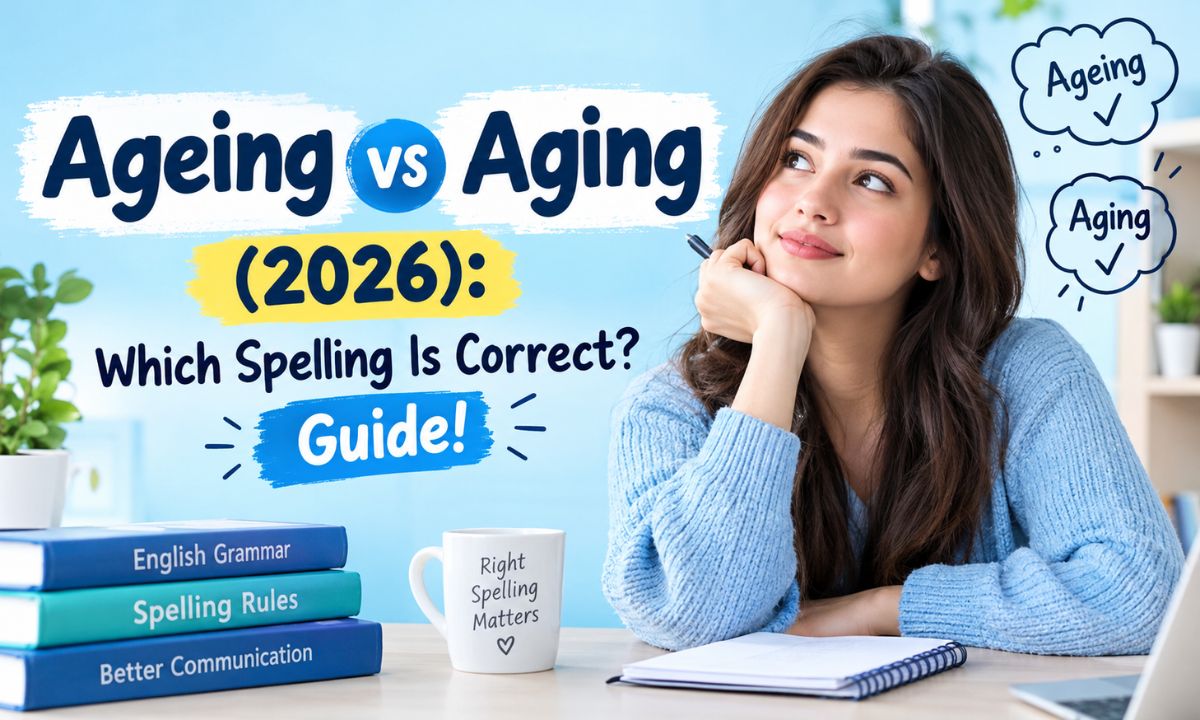
You have probably typed this word and then stopped. Did that look right? Should there be an “e” in the middle or not? You are not alone. Millions of writers pause at this word every year.
The good news is simple. Both spellings are correct. The real question is which one fits your reader. This guide explains the difference in plain English. It also shows you how to pick the right form every time, especially if you write for an American audience.
Quick Answer
If you write for readers in the United States, use aging. If you write for readers in the UK, Australia, or most Commonwealth countries, use ageing.
That is the whole rule. Both words mean the same thing. They describe the process of growing older. Only the spelling changes.
Here is a quick view:
| Spelling | Used In | Best For |
| Aging | United States, often Canada | American readers, US websites, US businesses |
| Ageing | United Kingdom, Australia, New Zealand, India | British style writing, global health reports |
Pick one and stay with it. That is the key.
What Is the Difference Between Ageing and Aging?
There is no difference in meaning. The only difference is spelling. American English drops the silent “e” from the base word “age” before adding “-ing.” British English keeps it.
This pattern is common across English. Americans often shorten words. British writers often keep older forms. Think of “color” and “colour,” or “center” and “centre.” Aging and ageing follow the same story.
The word itself works as a noun, a verb form, and an adjective. You can say “aging is natural,” “she is aging well,” or “an aging population.” The spelling rule applies in all three cases.
Ageing vs Aging Meaning
Both words mean the process of getting older. This can apply to people, animals, plants, buildings, wine, cheese, or machines. It can also mean something that looks older or is becoming old.
The meaning does not change with the spelling. A British doctor and an American doctor mean the same thing when they say it.
Ageing vs Aging Synonym
You can swap the word with others when you want variety. Useful synonyms include:
- Growing older
- Maturing
- Getting on in years
- Elderly (as an adjective)
- Senescence (a scientific term)
- Mellowing (often used for wine or cheese)
Remember that these are not always exact matches. “Maturing” sounds warm and positive. “Senescence” sounds technical.
Ageing vs Aging Examples
Here are simple pairs to show the spelling in action:
- American: The aging bridge needs repair.
- British: The ageing bridge needs repair.
- American: Aging is a normal part of life.
- British: Ageing is a normal part of life.
Notice that only one letter changes. Nothing else in the sentence is different.
Aging or Ageing Oxford Dictionary
The Oxford English Dictionary lists “ageing” as the main British spelling. It also notes “aging” as the standard American form. So Oxford supports both, but it leans British.
Oxford style guides for UK publishers prefer “ageing.” That is why you see it so often in British books and news.
Ageing vs Aging Oxford Dictionary
Many people search this phrase to settle a debate. The answer is the same. Oxford treats “ageing” as the preferred British form. It treats “aging” as the usual American one.
If your reader is American, follow American dictionaries such as Merriam-Webster. They list “aging” first.
Ageing vs Aging Reddit
Reddit threads on this topic are full of friendly arguments. Most users land on one clear point. The spelling depends on where you live and who you write for.
Some people say “ageing” looks more formal. Others say “aging” looks cleaner. Neither claim is a rule. It is just a personal taste.
Ageing vs Aging Quiz
Try this quick check. Pick the right spelling for an American blog post:
- The ______ population is growing fast. (aging)
- Skin ______ starts in your twenties. (aging)
- For a UK magazine, the ______ workforce is a big topic. (ageing)
If you choose aging for the first two and ageing for the third, you understand the rule.
Aging or Ageing in Accounting
Accountants use this word too. An “accounts receivable aging report” shows how long invoices have gone unpaid. In the US, the term is almost always “aging.”
In the UK and India, you may see “ageing analysis” or “ageing report.” The meaning is the same. The report groups unpaid bills by how late they are.
Read More: CM Mean
Why Both “Ageing” and “Aging” Are Correct

English has no single official rulebook. It grows through use. When two spellings are both widely used by educated writers, both count as correct.
That is the case here. Neither is a typo. Neither is slang. Dictionaries list both.
Think of it like “gray” and “grey.” One is common in the US. The other is common in the UK. Nobody calls either one wrong.
There is also a history behind this. In the early 1800s, an American writer named Noah Webster pushed for simpler spelling. He wanted words to match how people say them. Many of his changes stuck in the United States. Britain kept the older forms.
So the split is not random. It comes from a long story of language reform. Today, both versions are fully accepted in their own regions.
Here are the main reasons both are valid:
- Major dictionaries list both forms.
- Both appear in respected newspapers and journals.
- Each one is standard in a large group of English speakers.
- Neither one changes the meaning.
Detailed Explanation of British vs American Spelling
British and American English differ in many small ways. Spelling is one of the biggest. Most of these differences follow patterns, which makes them easier to learn.
Common patterns include:
| Pattern | American | British |
| -or / -our | color | colour |
| -er / -re | center | centre |
| -ize / -ise | organize | organise |
| Dropped “e” | aging | ageing |
| Single / double “l” | traveling | travelling |
Once you know these patterns, you can spot them everywhere. The aging and ageing split fits right in.
British English (Ageing)
British English keeps the final “e” of “age” when adding “-ing.” This helps readers see the root word clearly. Writers in the UK, Australia, New Zealand, and India usually follow this style.
British publishers and health bodies often use “ageing.” You will see it in government reports, university papers, and national news. Many global organizations that follow UK style also use it.
The extra “e” also helps avoid a small confusion. Without it, “aging” could look odd to some British readers, as if a letter were missing.
American English (Aging)
American English drops the “e.” The word becomes shorter and matches how it sounds. This is the standard in US newspapers, schools, hospitals, and businesses.
Canada sits in the middle. Canadian English mixes British and American habits. Many Canadian writers use “aging,” but “ageing” is not unusual there either.
For a US audience, “aging” is the safe and natural choice. Using “ageing” on an American site may look like a mistake to some readers.
Examples:
- American: “Aging in place is popular among older adults.”
- British: “Ageing in place is popular among older adults.”
Examples of Ageing and Aging in Sentences
Seeing the word in real sentences makes the rule stick. Below are clear examples in both styles. Each pair says the same thing.
British English:
- The ageing population is putting pressure on the NHS.
- She has an ageing laptop that still works well.
- The museum is restoring its ageing roof.
- Healthy ageing starts with good sleep and exercise.
- The ageing process affects everyone differently.
American English:
- The aging population is putting pressure on Medicare.
- She has an aging laptop that still works well.
- The museum is restoring its aging roof.
- Healthy aging starts with good sleep and exercise.
- The aging process affects everyone differently.
Short and simple. The only change is the missing “e.”
You can also use the word in other forms:
- Verb use: “Cheese is aging in the cellar.”
- Noun use: “Aging brings both wisdom and challenges.”
- Adjective use: “He cared for his aging parents.”
Common Mistakes People Make
Most errors with this word are small. They are easy to fix once you know what to look for.
Here are the mistakes you will see most often:
- Mixing both spellings in one article. This looks careless.
- Using British spelling on a US site. It can feel off to American readers.
- Writing “agin” or “ageing” with a typo. Simple slips happen.
- Thinking one spelling is wrong. Neither one is.
- Changing spelling inside a quote. Quotes should stay as the speaker wrote them.
Examples:
| Mistake | Better Version (US) |
| The aging and ageing process | The aging process |
| Our ageing workforce (on a US blog) | Our aging workforce |
| Healthy agin tips | Healthy aging tips |
A good habit is to use the find and replace tool before you publish. Search for the version you did not mean to use. This takes ten seconds and saves you from embarrassment.
Why People Get Confused Between Ageing and Aging
English is full of spelling rules with odd exceptions. This one feels strange because a rule that works almost everywhere seems to break here.
Normally, you drop the silent “e” before “-ing.” Think of “make” to “making” or “write” to “writing.” So “age” to “aging” feels right. But British English keeps the “e” in some words, such as “ageing,” “routeing,” and “singeing.” That is where the confusion starts.
There are other reasons people get mixed up:
- The internet mixes British and American content together.
- Spell checkers may accept both spellings.
- Global brands often use one style for all countries.
- People read both versions daily without noticing.
Another reason is that spell check tools are tied to a language setting. If your computer is set to UK English, it may flag “aging.” If it is set to US English, it may flag “ageing.” That can make you think one is a mistake.
The fix is easy. Set your tool to the right language for your audience.
Real-Life Usage in Different Contexts
The word shows up in many parts of daily life. Each field has its own habits. Knowing them helps you write with confidence.
Examples:
| Context | Common Use (US) | Common Use (UK) |
| Health news | aging population | ageing population |
| Skincare | anti-aging cream | anti-ageing cream |
| Business | aging inventory | ageing inventory |
| Food and drink | aged cheese, aging wine | ageing wine |
| Technology | aging hardware | ageing hardware |
Brands also choose carefully. A skincare company that sells in the US will usually say “anti-aging.” One that sells in the UK will say “anti-ageing.” Global brands often make two versions of their pages.
You will also see the word in job ads, law, and real estate. Each field follows the spelling of its home country.
Ageing or Aging in Scientific Writing – Which One Is Used?
Science does not pick one side. It follows the journal, the country, and the editor.
Many top journals use their own house style. For example, some research journals use “ageing” in their titles because they started in Europe. Others use “aging” because they began in the US. Both are respected.
The World Health Organization often uses “ageing” in its reports. The US National Institute on Aging uses “aging.” So the spelling tells you about the organization, not the quality of the work.
Examples:
- A UK university paper: “Mechanisms of cellular ageing”
- A US research paper: “Mechanisms of cellular aging”
If you are submitting a paper, check the journal’s author guidelines first. They will tell you which spelling to use. Follow them exactly.
Here is a short checklist for scientific writers:
- Read the journal’s style page.
- Match the spelling in your title, abstract, and body.
- Keep reference titles as they were originally published.
- Run a final search to catch mixed spellings.
Ageing or Aging in Psychology and Daily Life Usage
Psychology uses this word often. It talks about aging and memory, aging and mood, and aging and identity. The spelling follows the writer’s region.
In the United States, textbooks and clinics use “aging.” In the UK, they use “ageing.” The ideas are identical.
In daily life, people care less about spelling and more about the message. Most readers will not stop and check. Still, a consistent spelling makes your writing look polished.
Examples:
- “Aging gracefully means caring for your mind as well as your body.” (US)
- “Ageing well is as much about friendships as it is about fitness.” (UK)
- “Many people feel more confident as they grow older.” (neutral wording that avoids the issue)
If you ever want to sidestep the spelling question, you can use phrases like “growing older” or “later life.” These work for any audience. But if your goal is search traffic, using the exact keyword matters more.
Ageing or Aging in Digital Content and SEO Writing
Spelling choices matter online. Search engines treat “aging” and “ageing” as related, but results can differ by region. A person in New York who types “aging” may see different results from a person in London who types “ageing.”
For a US audience, “aging” is the better primary keyword. It matches what Americans type into search bars. It also matches the way American sites write.
Here is how to handle both in SEO:
- Use “aging” in your title, headings, and URL for US readers.
- Mention “ageing” once or twice if you want to catch UK searches.
- Keep your spelling consistent across the whole page.
- Set your page language to US English in your site settings.
Examples:
| Page Goal | Best Keyword |
| US skincare blog | anti-aging tips |
| UK health charity | healthy ageing advice |
| Global explainer (like this one) | ageing vs aging |
Voice search adds another twist. When people speak, there is no spelling at all. Smart assistants then match the spoken word to the user’s region. So clear, helpful answers matter more than spelling tricks.
Ageing or Aging in Style Guides and Grammar Rules
Professional writers follow style guides. These guides settle debates so teams stay consistent. Most of them have a clear view on this word.
| Style Guide | Preferred Spelling |
| Associated Press (AP) | aging |
| Chicago Manual of Style | aging |
| Merriam-Webster | aging |
| Oxford (UK) | ageing |
| The Guardian style guide | ageing |
If you write for a US newsroom or publisher, “aging” is almost always the rule. If you write for a British outlet, it is “ageing.”
Examples:
- A US magazine edits “ageing” to “aging” before printing.
- A UK newspaper edits “aging” to “ageing” for the same reason.
When you have no guide, make a small rule for yourself. Write it down in a style sheet. Something like: “We use US spelling. That means aging, color, and organization.” Then follow it every time.
Ageing or Aging – Why Consistency Matters in Writing
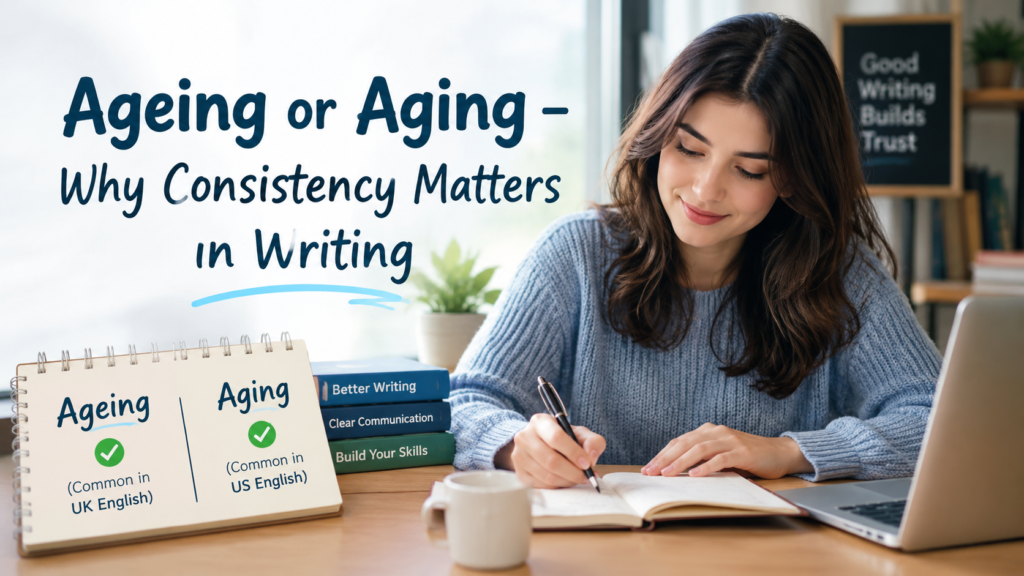
Consistency is a sign of care. Readers may not notice the correct spelling. They often notice an inconsistent one.
If one page says “aging” and the next says “ageing,” readers wonder if anyone checked the work. It can lower trust, especially in health, finance, and education content.
Consistency also helps your brand. A steady voice feels professional. It tells readers that your team pays attention to detail.
Examples:
- Good: “Aging affects bone health. Healthy aging includes strength training.”
- Weak: “Aging affects bone health. Healthy ageing includes strength training.”
Simple ways to stay consistent:
- Choose US or UK English before you start.
- Set your spell checker to match.
- Create a short style sheet for your team.
- Read your final draft once, only for spelling.
- Use find and replace for the alternate spelling.
Ageing vs Aging Comparison
Here is a full side by side look. Use it as a quick reference whenever you are unsure.
| Feature | Aging | Ageing |
| Meaning | Growing older | Growing older |
| Main region | United States | UK, Australia, NZ, India |
| Spelling style | American | British |
| Silent “e” | Dropped | Kept |
| AP and Chicago style | Yes | No |
| Oxford UK style | No | Yes |
| Best for US SEO | Yes | Only as a secondary term |
| Correct or wrong? | Correct | Correct |
The table makes one thing clear. These are twins. They differ only in dress, not in character.
A few more points to remember:
- Pronunciation is the same for both.
- Related words follow the pattern too, such as “ageless” and “ageism,” which keep the “e” in both styles.
- Compound words like “anti-aging” and “anti-ageing” follow the same split.
Role in Communication
Spelling is a small part of communication, but it sends a signal. It tells the reader who you are and who you are writing for.
When you choose “aging” for an American audience, you show that you understand your readers. Your message feels local and natural. When you choose “ageing” for a British audience, you do the same thing in the other direction.
Good communication is about clarity and trust. Spelling supports both. A reader who does not trip over a word can focus on your ideas.
Here is how spelling helps communication:
- It keeps the reading flow smooth.
- It builds credibility.
- It avoids distractions.
- It shows respect for the reader’s language habits.
In business, this matters even more. A small spelling slip in an email, report, or ad can reduce trust. Matching your audience shows care and professionalism.
Long-Term Benefits of Correct Usage
Using the right spelling consistently pays off over time. It may seem minor today. But small habits build strong writing skills.
Here are the long-term benefits:
| Benefit | How It Helps |
| Stronger credibility | Readers trust polished content |
| Better SEO results | Matching keywords brings the right traffic |
| Cleaner brand voice | Your content feels unified |
| Fewer edits | You save time on fixing errors |
| Wider reach | You can adapt content for US and UK readers |
Writers who learn these small rules also grow faster. They spot patterns and apply them to other words. After learning this one, you will find “color” and “colour” much easier.
Over time, careful spelling builds a reputation. Your readers learn that your content is reliable. That is hard to buy and easy to lose.
Frequently Asked Questions
Is it aging or ageing in American English?
In American English, the correct spelling is “aging.” The silent “e” is dropped. This is the form used by AP, Chicago, and Merriam-Webster.
Is ageing a wrong spelling?
No, “ageing” is not wrong. It is the standard British spelling. It is widely used in the UK, Australia, and many other countries.
Do aging and ageing have the same meaning?
Yes, they have exactly the same meaning. Both describe the process of growing older. Only the spelling is different.
Which spelling should I use for SEO in the USA?
Use “aging” as your main keyword for US readers. You can add “ageing” once or twice to catch some UK searches.
Can I use both aging and ageing in one article?
It is best not to. Pick one spelling and stay consistent. The only exception is when you explain the difference, as in this guide.
Final Thoughts
Aging and ageing are both correct. They mean the same thing and sound the same. The only difference is where you are writing from. Americans use “aging,” while British English prefers “ageing.”
For a United States audience, go with “aging” and keep it consistent from the first line to the last. Set your spell checker, follow your style guide, and do one final check before you publish. These small steps make your writing clear, trusted, and professional.

Noah is a passionate content writer and language enthusiast who enjoys making difficult words, phrases, and text meanings easy to understand. He creates clear, simple, and useful articles with practical examples to help readers improve their vocabulary and everyday language skills.