
You open a message and see two words: “idc.” Maybe a friend sent it. Maybe a crush. Maybe a group chat. You stare at the screen and wonder if you did something wrong.
Short slang can carry big feelings. IDC is one of the most common examples. It looks simple, but the tone behind it can change everything. This guide explains what IDC means in text, where it came from, how people use it, and how to reply without making things awkward.
Quick Answer
In text, IDC means “I don’t care.” People use it to say they have no strong opinion, no preference, or no interest in something.
The tone matters a lot. “IDC, you pick the movie” is friendly and relaxed. “Idc what you do” can sound cold or angry. Outside of texting, IDC can also mean other things, like a type of breast cancer or a technology research firm. Context tells you which one is meant.
Quick Overview Table
Here is a fast look at the most common meanings of IDC.
| Context | What IDC Stands For | Example |
| Texting and chat | I don’t care | “Idc where we eat.” |
| Medical | Invasive ductal carcinoma | “The biopsy showed IDC.” |
| Business | International Data Corporation | “IDC released a new market report.” |
| Accounting | Interest during construction | “IDC was added to the project cost.” |
| Government | Varies by agency (often a committee or center) | “The IDC meets on Monday.” |
| Law | Often immigration detention center | “He was held at an IDC.” |
Most people in the US who search for this term want the texting meaning. The rest of this article focuses on that, but it also covers the other uses so you are never confused.
What Does IDC Mean in Text?

IDC is short for “I don’t care.” It is typed in lowercase most of the time. It is quick, casual, and common in private chats, comments, and captions.
The phrase can mean two very different things. It can mean “I’m easy, either option works for me.” Or it can mean “This does not matter to me at all.” One is polite. The other can hurt.
Because the letters never change, you have to read the situation. Look at the words around it, the emojis, the timing, and the person’s usual style. That is how you find the real meaning.
IDC meaning medical
In medicine, IDC usually stands for invasive ductal carcinoma. It is the most common type of breast cancer. It starts in the milk ducts and then spreads into nearby breast tissue.
Doctors often see IDC in biopsy results and pathology reports. If you or a loved one gets this result, treatment depends on the stage, the grade, and hormone receptor status. A cancer care team can explain the next steps.
This meaning is serious. It has nothing to do with the slang version. If you see IDC in a medical document, do not read it as “I don’t care.”
IDC meaning in government
In government, IDC can stand for different things. It depends on the agency and the country. Common examples include interdepartmental committees, interagency coordination groups, or specific centers and districts.
There is no single official meaning that applies everywhere. Government documents usually spell out the full name the first time it appears. After that, they use the short form.
If you find IDC in a government file, look for the first mention of the term. It will almost always explain the acronym.
IDC meaning business
In business and tech, IDC often means International Data Corporation. It is a well-known market research and advisory firm. It publishes reports on technology, data, and digital trends.
You may see it in news stories like “IDC reports that global smartphone shipments grew.” In that case, it refers to the research company, not a feeling.
Some companies also use IDC for “internet data center.” This is a facility that stores servers and network equipment. Again, context makes the meaning clear.
Idc meaning in accounting
In accounting and finance, IDC commonly means interest during construction. It is the interest that builds up while a large project is being built, before it starts earning money.
Companies often add this cost to the total value of the asset. Think of power plants, bridges, or large buildings. The interest paid during the build period becomes part of the project cost.
Some businesses also use IDC for internal charges between departments. Accountants check the company’s own definitions to be sure.
Idc meaning in english
In everyday English, IDC means “I don’t care.” It is a casual abbreviation, just like IDK means “I don’t know” and IMO means “in my opinion.”
Teachers, editors, and formal writers do not use it. It belongs in texts, chats, and social media. In a school paper or a work email, write the full phrase or choose a softer one.
You can also say it out loud as three letters, “I-D-C.” Some people do this as a joke. It is rare in normal speech.
IDC meaning breast cancer
When people search “IDC meaning breast cancer,” they usually want to understand a diagnosis. IDC is short for invasive ductal carcinoma. It makes up roughly 70 to 80 percent of breast cancer cases.
“Invasive” means the cancer cells have moved out of the duct. It does not always mean the cancer has spread to other parts of the body. The stage will tell you more.
Treatment may include surgery, radiation, chemotherapy, hormone therapy, or targeted therapy. The right plan depends on the person. Always talk with a doctor for personal medical advice.
Idc meaning in chat
In chat apps, IDC means “I don’t care” or “I’m fine with anything.” You will see it in group chats, direct messages, and gaming chats.
Chat is fast. People drop letters to save time. IDC fits that habit well. It is short enough to send in a second.
The risk is that chat has no voice or face. Without tone, a simple “idc” can feel colder than the sender planned.
IDC meaning law
In law, IDC is not one fixed term. A common legal and immigration use is immigration detention center. Other uses depend on the court, the state, or the agency.
Legal writing nearly always defines an acronym before using it. If you see IDC in a legal document, check the first page or the glossary.
For legal questions, speak with a licensed attorney. A text slang meaning will not apply in a courtroom.
What does idc mean in text
If you are asking “what does idc mean in text,” the answer is simple. It means “I don’t care.” That is the meaning in about 95 percent of casual messages.
It can show that you are flexible. It can also show that you are bored, annoyed, or hurt. The words around it help you decide.
Read More: HY Meaning in Text
Idc in text
“IDC in text” usually shows up as a short reply. Someone asks a question, and the answer is “idc.”
It may stand alone, or it may come with extra words. “Idc, whatever you want” is warm. “Idc.” with a period that is much colder. Punctuation matters more than most people think.
Idc mean
When people type “idc mean,” they are often asking, “What does IDC mean?” The answer stays the same. It means “I don’t care.”
Some people also type “idc mean” by accident while writing “IDC, I mean…” as a way to correct themselves. Context shows which one it is.
What does idc
“What does IDC” is a common search phrase, often followed by “mean” or “stand for.” The short answer is that IDC stands for “I don’t care” in texting.
If the message came from a doctor, a business, or a government office, think about the other meanings in the table above.
What does idc stand for
IDC stands for “I don’t care” in slang. In other fields, it can stand for invasive ductal carcinoma, International Data Corporation, interest during construction, or several other terms.
Here is a simple way to remember it:
- Friend or family chat: I don’t care
- Doctor’s report: Invasive ductal carcinoma
- Tech news: International Data Corporation
- Finance report: Interest during construction
IDC Meaning in Chat Conversations
Chat is where IDC lives. It is easy to type and easy to misread. A person might send it while walking, cooking, or watching TV, and not think much about it.
On the other side of the screen, the reader may take it personally. That gap causes many small arguments. Knowing the common patterns helps you stay calm.
Below are the three main ways people use IDC in conversation.
IDC as a Casual Response
This is the friendliest use. The sender has no strong preference and wants to make things easy.
Examples:
- “Idc, pizza or tacos.”
- “Idc what time we meet.”
- “Idc about the color, both look good.”
In these cases, IDC means “I’m flexible.” It often comes with a choice, a smile, or a laugh. It helps the group decide faster.
IDC as a Dismissive Reply
Sometimes IDC is a way to shut a topic down. The sender may feel tired, annoyed, or ignored.
Examples:
- “Idc.”
- “Idc what you think.”
- “Do what you want, idc.”
Here, the message is short and flat. It often has no emoji. It may come after a disagreement. The writer is not saying “I’m easy.” They are saying “I’m done talking.”
IDC in Emotional Situations
IDC can also be a shield. People say it when they care a lot but do not want to show it.
For example, someone may text “idc if he comes to the party” when they are actually hurt that he was not invited. The words say “no feelings.” The timing says the opposite.
If a friend uses IDC this way, do not argue. Gently ask how they are really doing. A kind check-in often opens the door.
IDC Meaning on Social Media Platforms
IDC appears on every major app, but each platform gives it a slightly different feel. The audience, the format, and the pace all change how people read it.
The table below gives a quick view.
| Platform | Typical Use of IDC | Common Tone |
| Private chats and group plans | Casual or flexible | |
| Comments, captions, DMs | Playful or sassy | |
| Snapchat | Quick replies and streak chats | Light and fast |
| TikTok | Comments and video captions | Bold, funny, or defiant |
IDC on WhatsApp
On WhatsApp, IDC is mostly used in planning. Friends and family use it to say they are open to any option.
In big groups, one “idc” can save time. In one-on-one chats, it can feel sharper. A reply of “idc” to a heartfelt message may seem rude.
Voice notes can fix this. If you worry about tone, record a short message instead.
IDC on Instagram
On Instagram, IDC shows up in captions, comments, and DMs. Many users add it to posts to look confident or relaxed.
A caption like “idc if it’s cloudy, I’m wearing sunglasses” is playful. A comment like “idc who agrees” can be a bit defiant.
In DMs, it works like a regular text. Replies to stories often use it in a funny way.
IDC on Snapchat
Snapchat moves fast. Messages disappear, and people reply in seconds. IDC fits well because it is short.
Most Snapchat uses are light. “Idc where we go” or “idc, I’m down” is common. Because chats feel temporary, people worry less about tone.
Still, the same rule applies. If the message is flat and cold, it will feel that way even on Snapchat.
IDC on TikTok
On TikTok, IDC often appears in comments and on-screen text. Creators use it to show attitude, such as “idc what people say, I’m doing it.”
It can be a joke, a flex, or a form of self-confidence. It can also be sarcasm. A viral video might use “idc” in a funny sound or caption.
Trends change fast on TikTok. The meaning stays the same, but the style around it keeps shifting.
Why People Use IDC in Texting
People use IDC for a few simple reasons. The first is speed. Typing three letters is faster than typing a full sentence.
The second reason is comfort. Saying “I don’t care” in full can sound strong. The short version feels lighter, even when the message is the same.
Other common reasons include:
- To avoid making a decision
- To keep the mood relaxed
- To show confidence
- To hide hurt feelings
- To end a debate quickly
- To match the casual style of a group
Habit also plays a big part. Once a friend group uses a word, everyone starts using it. It becomes part of how they talk.
Different Meanings of IDC Based on Context
The same three letters can point to very different things. The best way to decode them is to ask three questions. Who sent it? Where was it sent? What came before it?
A message from a friend on iMessage is likely slang. A line in a lab report is likely medical. A headline in a tech magazine is likely a company.
This table puts it all in one place.
| Where You See It | Most Likely Meaning |
| Text from a friend | I don’t care |
| Group chat | I’m flexible or I don’t mind |
| Hospital report | Invasive ductal carcinoma |
| Business news | International Data Corporation |
| Financial statement | Interest during construction |
| Government paper | Depends on the agency |
| Legal or immigration file | Often immigration detention center |
If you are still unsure, ask the sender. A quick “Do you mean I don’t care?” clears things up.
Real-Life Usage Examples
Examples make slang easier to understand. Below are three common situations with different tones. Each one shows how the same word can feel very different.
Notice how the small details change the meaning. These include punctuation, emojis, and the words around IDC.
Example 1: Neutral Use
Friend A: “Where do you want to eat tonight?” Friend B: “idc, you pick 😊”
This is a friendly use. Friend B has no strong choice and trusts Friend A. The smiley face adds warmth. Nothing here is negative.
You can reply with a quick choice. For example, “Cool, let’s get burgers.”
Example 2: Slightly Rude
Person A: “I think we should rethink the plan.” Person B: “idc. do whatever.”
This version sounds cold. The period after “idc” feels sharp. The phrase “do whatever” adds distance.
Person B may be frustrated, tired, or upset. The reader might feel brushed off. A calm reply like “Okay, I’ll sort it out. Let me know if you change your mind” can lower the tension.
Example 3: Emotional Use
Person A: “Are you going to see him at the party?” Person B: “idc honestly… it’s fine.”
The ellipsis and “honestly” give it away. Person B probably cares more than they admit. The words try to look calm, but the tone shows pain.
A good reply might be, “I get it. If you want to talk, I’m here.” That response respects their feelings without pushing too hard.
How IDC Is Used in Different Age Groups
Teens and young adults use IDC the most. It is part of their daily chat style, along with other short forms like “ngl,” “fr,” and “idk.”
Millennials also use it, but often with more context. They may add a full sentence or an emoji to soften it. Older adults tend to write out “I don’t care” or “I don’t mind.”
Parents and grandparents may find IDC confusing. If your mom texts “What does idc mean?”, it is a normal question. A simple answer is, “It means I don’t care.”
Here is a quick comparison:
| Age Group | How They Use IDC |
| Teens (13 to 19) | Very often, casual and quick |
| Young adults (20 to 30) | Often, mixed with other slang |
| Adults (30 to 50) | Sometimes, usually in friendly chats |
| Older adults (50+) | Rarely, may need it explained |
Workplaces also differ. Some casual teams use IDC in Slack. Most formal offices do not. When in doubt, skip it at work.
Psychological Meaning Behind IDC
Behind IDC, there is often more than “I don’t care.” Psychology shows that people use short, flat words to protect themselves. It feels safer than showing strong emotion.
Saying “idc” can signal a few different mindsets:
- Flexibility: The person truly does not mind.
- Avoidance: They want to skip a hard choice.
- Self-protection: They fear looking too invested.
- Withdrawal: They feel hurt and are pulling back.
- Fatigue: They are too tired to decide.
Sometimes IDC is a power move. Acting like you do not care can feel like staying in control. But over time, it can also push people away.
If you use IDC a lot, ask yourself why. Is it because you are relaxed? Or is it because you feel unheard? Honest answers can improve your relationships.
IDC in Online Culture and Trends
Online culture loves short phrases that sound cool and unbothered. IDC fits that mood. It shows up in memes, bios, captions, and video comments.
The “I don’t care” attitude also ties into larger trends. Many creators promote self-confidence and doing things your own way. Phrases like “idc what they think” appear in motivational posts and personal branding.
At the same time, there is a flip side. Some people use IDC to dodge accountability or to act edgy. Internet culture tends to notice this and joke about it.
The slang itself is stable. It has been around for many years and is still common in 2026. New slang may come and go, but IDC remains a basic part of texting vocabulary.
Common Mistakes When Using IDC
IDC looks easy, so people rarely think about how they use it. A few small habits can lead to big misunderstandings.
Watch out for these mistakes:
- Using it in serious talks. A flat “idc” during an emotional conversation can feel cruel.
- Adding a period. “Idc.” sounds colder than “idc.”
- Using it with elders or bosses. It may look disrespectful.
- Mixing it up with IDK. One means “I don’t care.” The other means “I don’t know.”
- Sending it when angry. Heat of the moment replies are hard to take back.
- Assuming everyone knows it. Some people, especially older ones, may not.
A simple fix is to add a few more words. “Idc, I’m happy with either” sounds kinder than “idc.”
How to Respond When Someone Says IDC
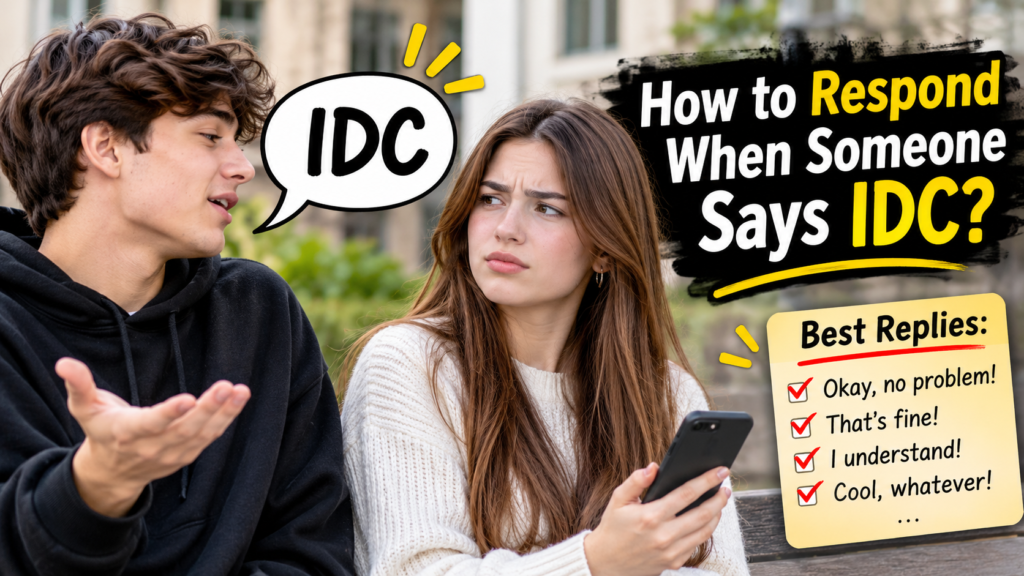
Your reply depends on the tone. First, figure out whether the person is relaxed or upset. Then match your response.
If they sound relaxed:
- “Great, then let’s go with option A.”
- “Okay, I’ll choose. Thanks for being flexible.”
If they sound annoyed:
- “Hey, did I say something wrong?”
- “I feel like something is off. Want to talk?”
If they sound hurt:
- “I’m here if you need me.”
- “No pressure, but I care how you feel.”
Do not respond with anger. A calm, kind message often gets a better result. If the topic matters, suggest a call. Tone is easier to read when you can hear a voice.
When to Use IDC
IDC works best in relaxed settings where the stakes are low. It is a friendly shortcut when you truly do not mind.
Good times to use it:
- Choosing a restaurant, movie, or game
- Planning a casual hangout
- Replying to a friend who gives you options
- Joking in a group chat
- Showing confidence in a social media caption
Add a smiley, a laugh, or a few extra words to keep the tone warm. For example, “idc, I’m easy 😄” feels welcoming.
When NOT to Use IDC
Some moments call for care. IDC can sound harsh when someone is sharing something important.
Avoid it in these cases:
- When a friend is sad or stressed
- During arguments or serious talks
- In messages to teachers, bosses, or clients
- When someone asks for your honest opinion
- In emails or formal writing
- When talking about health, money, or safety
In these cases, write a full and clear message. “I don’t mind either way, but I’m happy to help decide” is better than a single flat word.
Similar Slang Terms to IDC
IDC has many cousins in texting. Some mean almost the same thing. Others are close but carry a different tone.
| Slang | Meaning | Tone |
| IDK | I don’t know | Neutral |
| IDGAF | I don’t give a f***, strong version of IDC | Rude or bold |
| IDRC | I don’t really care | Softer |
| Whatever | Dismissive or flexible | Can be cold |
| Meh | Not excited | Mild |
| NBD | No big deal | Friendly |
| IDM | I don’t mind | Polite and warm |
| TBH | To be honest | Neutral |
IDM is a nice choice when you want to be easygoing without sounding cold. IDRC is also softer. Both can replace IDC in sensitive chats.
Why IDC Is So Popular
IDC is popular because it is simple. Three letters carry a full thought. It saves time and fits any app.
It also matches how people talk online. Texting is fast and informal. Short forms feel natural. IDC sounds relaxed, and many people like that.
There is one more reason. IDC works in many moods. It can be funny, calm, confident, or sad. That flexibility makes it useful. People can use it in countless ways with only three letters.
IDC Meaning Based on Tone
Tone is the key to reading IDC. The same word can feel kind, cold, or painful. Learning to spot the difference helps you reply better and avoid fights.
Use the table below as a quick guide.
| Tone | Signs | What It Likely Means |
| Neutral | Emoji, extra words, a choice offered | I’m flexible |
| Rude | Period, short reply, “whatever” | I’m annoyed or done |
| Emotional | “Honestly,” ellipsis, late reply | I care but I’m hiding it |
Neutral Tone:
In a neutral tone, IDC is easygoing. The sender wants to be helpful and lets you decide.
Look for friendly clues. These include emojis, laughter, or a follow-up like “you choose.” The message feels open, not closed.
Example: “idc, whatever works for you 😊”
Rude Tone:
In a rude tone, IDC is sharp. It can be a way to end a talk or show anger.
Look for short replies, a period at the end, and cold phrases such as “do what you want.” There may also be a long pause before the message.
Example: “idc. do what you want.”
Emotional Tone:
In an emotional tone, IDC hides stronger feelings. The sender may feel sad, jealous, or hurt.
Look for hints like “honestly,” “it’s fine,” or an ellipsis. The words say “no problem,” but the mood says something else.
Example: “idc honestly… it’s whatever.”
Advanced Insight: How Tone Changes Meaning
Text strips away voice, face, and body language. That is why one small word can cause so much stress. Readers fill the gap with their own mood. If you feel insecure, you may read “idc” as rejection. If you feel calm, you may read it as flexible.
To read tone better, look at the full picture:
- Timing: A fast reply feels casual. A slow, short reply feels cold.
- Punctuation: A period feels final. No punctuation feels relaxed.
- Capital letters: “IDC” in caps can sound loud or angry. Lowercase “idc” feels softer.
- Emojis: A smile or laugh softens the message. A flat face or none at all can sound distant.
- History: Think about how the person usually writes.
The same advice applies when you send it. Before you press send, ask yourself how the other person might feel. A few extra words can protect a friendship.
When in doubt, ask. A short message like “Do you mean you’re fine with anything, or are you upset?” can prevent a lot of confusion. Clear talk beats guessing every time.
Frequently Asked Questions
What does IDC mean in text?
IDC means “I don’t care” in text. It can show flexibility or disinterest, depending on tone.
What does IDC stand for in medical terms?
In medicine, IDC stands for invasive ductal carcinoma, the most common type of breast cancer.
Is IDC rude to say in a text?
It can be. A flat “idc.” sounds cold, while “idc, you pick 😊” sounds friendly.
What is the difference between IDC and IDK?
IDC means “I don’t care,” while IDK means “I don’t know.” They look alike but have different meanings.
How should I reply when someone texts IDC?
Check the tone first. If it sounds relaxed, make a choice. If it sounds upset, ask kindly what is wrong.
Final Thoughts
IDC mostly means “I don’t care” in text, but the real meaning lives in the tone. It can be easygoing, rude, or even a cover for hurt feelings. Outside of slang, it can also mean invasive ductal carcinoma, International Data Corporation, interest during construction, and other terms.
The best habit is to read the context before you react, and to write with care before you send. Add a few friendly words, use softer options like IDM, and ask when you are unsure. Small choices in texting can make your conversations warmer and clearer in 2026 and beyond.

Noah is a passionate content writer and language enthusiast who enjoys making difficult words, phrases, and text meanings easy to understand. He creates clear, simple, and useful articles with practical examples to help readers improve their vocabulary and everyday language skills.