

Scrap and scrape look almost the same. They sound close too. But they do not mean the same thing, and mixing them up can change your whole sentence.
This guide explains both words in plain English. You will see meanings, examples, past tense forms, and real-life uses. By the end, you will know exactly which word fits your sentence.
Quick Answer
Scrap means a small leftover piece, or to throw something away or cancel it. Scrape means to rub a rough edge across a surface, or to remove something by rubbing.
Here is the fastest way to tell them apart:
- Use scrap when you talk about leftovers, junk, or canceling a plan.
- Use scrape when you talk about rubbing, scratching, or removing a layer.
| Word | Main Meaning | Quick Example |
| Scrap | A leftover piece, or to discard | We scrapped the old plan. |
| Scrape | To rub or remove from a surface | He scraped the ice off the car. |
Quick Overview of Scrap vs Scrape
Both words can be a noun or a verb. That is one reason people mix them up. But the actions behind them are very different.
Think of scrap as “throw away” or “small leftover.” Think of scrape as “rub against” or “scratch.” If your sentence has friction, you probably need to scrape. If it has leftovers or cancellation, you probably need scrap.
Below, we cover the most common questions people search for.
Scrap meaning in Medical
In medicine, the word scrap is not a standard term. You will not see it in a doctor’s chart. The word doctors use is scrape or scraping.
A medical scraping is a small sample taken from the skin or tissue. For example, a doctor may scrape a patch of skin to test for a fungal infection. Another common procedure is curettage, where tissue is gently scraped away from an area.
So if you see “scrap” in a medical sentence, it is likely a typo for “scrape.”
Scrap vs scrape pronunciation
The vowel sound is the main difference.
| Word | Pronunciation | Sounds Like |
| Scrap | /skræp/ | “skrap,” with a short “a” like in cap |
| Scrape | /skreɪp/ | “skrayp,” with a long “a” like in tape |
Say them out loud. Scrap is short and quick. Scrape is longer and stretches out. That long “a” in scrape matches the silent “e” at the end of the word.
Scrapped or scraped knee
The correct phrase is scraped knee. A scraped knee means the skin was rubbed off by a rough surface, like pavement.
Scrapped knees is a common mistake. A knee cannot be thrown away or canceled. So always write “I scraped my knee.”
Scrap vs scrape price
People often search this when they want to sell metal or pay for a service.
- Scrap price is the amount a recycler pays for old metal, such as copper, aluminum, or steel. Prices change often. They depend on the metal type, weight, and market demand.
- Scrape price has no standard meaning. It might refer to the cost of a scraping service, such as paint removal.
If you want to sell metal, call a few local scrapyards in the US and compare their rates per pound.
Scrapping or scraping metal
Scrapping metal means selling or recycling old metal. It is a popular side income for many Americans. People scrap old appliances, pipes, wires, and car parts.
Scraping metal means rubbing a tool against metal to remove rust, paint, or dirt. A wire brush or a putty knife often does the job.
Both phrases are correct. They describe two different jobs.
Scrap vs scrape car
- Scrap a car means to sell or junk it. The yard crushes it and recycles the metal.
- Scrape a car means to damage the paint by rubbing it against something. It can also mean scraping ice off the windshield in winter.
So “I scrapped my car” means you got rid of it. “I scraped my car” means you left a mark on it.
Scrape vs scrap past tense
Both words follow a simple rule for past tense. Add -ed. But the spelling of scrap changes a little.
| Base Form | Past Tense | Present Participle |
| Scrap | Scrapped (double “p”) | Scrapping |
| Scrape | Scraped (single “p”) | Scraping |
The word scrap is short and ends in one vowel plus one consonant. That is why the final “p” doubles. The word scrape already ends in “e,” so you only add “d.”
Scrap vs scrape furniture
- Scrap furniture means to throw out old or broken pieces.
- Scrape furniture means to remove old paint or varnish from wood, often before refinishing.
If you restore an old chair, you scrape it. If the chair is beyond repair, you scrap it.
Read More: DPMO Mean in Text
What Does “Scrap” Mean?
Scrap has several meanings. The two most common are a small leftover piece and the act of discarding something.
As a noun, a scrap is a bit of something that remains. Think of food scraps, paper scraps, or fabric scraps. As a verb, to scrap something means to get rid of it or cancel it. It also has an informal meaning. A scrap can be a small fight or argument.
The word often carries a sense of “no longer useful.” That is the idea you should keep in mind.
Examples of “Scrap”
- She saved every scrap of fabric for her quilt.
- The company scrapped the project after three months.
- The dog ate the scraps from the table.
- He sold scrap metal for extra cash.
- The two boys got into a scrap at recess.
- Please don’t scrap the whole idea yet.
What Does “Scrape” Mean?
Scrape means to rub something rough or sharp across a surface. The result can be a scratch, a mark, or the removal of a layer.
As a verb, you can scrape paint off a wall or scrape butter across toast. You can also scrape your arm on a fence. As a noun, a scrape is a minor injury, like a scratch or graze. It can also mean a tight spot or a tough situation. For example, “He got into a scrape with the law.”
You can also scrape by, which means to barely manage. This idiom is common in American English.
Examples of “Scrape”
- I scraped the frost off my windshield.
- She scraped her elbow on the sidewalk.
- He scraped the burnt bits from the pan.
- The family barely scraped by last winter.
- The chair scraped against the floor.
- Scrape the mud off your boots before you come in.
scrape food meaning
When we say “scrape food,” we mean to push leftover food off a plate or out of a pan. You usually use a spatula, spoon, or knife.
For example, you might scrape scraps into the trash after dinner. Notice how both words show up here. You scrape the scraps. The action is scraping. The leftovers are scraps.
scrape or scrap
Ask yourself one simple question. “Is something rubbing, or is something being tossed?”
If it is rubbing or removing a layer, choose scrape. If it is leftovers or throwing something away, choose scrap.
scrapped or scraped
Use scrapped when something was canceled or discarded. Use scraped when something was rubbed or scratched.
- The team scrapped the new design.
- The cat scraped the couch.
scrap vs scrape
The two words come from similar roots, but their jobs are different. Scrap is about leftovers and letting go. Scrape is about friction and removal.
Keep that split in mind and you will rarely go wrong.
scrape vs scrap
Some people flip the order when they search. The meaning does not change. Scrape still means to rub or remove. Scrap still means a leftover or to discard.
The order of the words has no effect on how you use them in a sentence.
Key Differences Between Scrap and Scrape
The easiest way to compare them is side by side.
| Feature | Scrap | Scrape |
| Core idea | Leftover or discard | Rub or remove |
| Noun meaning | A small piece, junk, or a small fight | A scratch or a tight spot |
| Verb meaning | To throw away or cancel | To drag across a surface |
| Past tense | Scrapped | Scraped |
| Vowel sound | Short “a” | Long “a” |
| Example | Scrap the plan. | Scrape the paint. |
Here are the main differences in short points:
- Action: Scrap is about letting go. Scrape is about touching and rubbing.
- Spelling: Scrape has a silent “e” at the end.
- Sound: Scrape has a long “a.”
- Use in injury: Only scrape is used for skin injuries.
- Use in recycling: Only scrap is used for old metal and waste.
Historical Origin of Scrap and Scrape
Both words are old. They entered English hundreds of years ago and grew from simple, everyday ideas.
Scrape came first in the sense of rubbing a surface. It was used to describe cleaning or scratching long before modern tools existed. Scrap came later. It started as a word for small bits and leftover food. Over time, it grew to mean anything cast aside.
Their history helps explain why they feel so close. Both came from the same kind of language family and both describe small, rough, everyday actions.
Examples
- In older English, “scraps” often meant leftover bits of food.
- “Scraping” was used for cleaning hides and tools.
- Later, “scrap” grew into the world of business and recycling.
The Etymology and Linguistic Roots of “Scrap” and “Scrape”
Both words trace back to Old Norse. Old Norse was the language of the Vikings. Many everyday English words came from it.
Scrape is linked to the Old Norse word skrapa, which means to scratch or erase. Scrap is linked to the Old Norse word skrap, which means small bits or trifles. The two share a similar root sound. That is why they look alike today.
Over centuries, English changed the spelling and sound. The long vowel in scrape and the short vowel in scrap helped separate their meanings.
Examples:
| Old Norse Root | Meaning | Modern English |
| skrapa | to scratch or erase | scrape |
| skrap | trifles, small bits | scrap |
Language experts note that similar-sounding words often share a root. This does not mean they are interchangeable. It only shows how English grew over time.
Scrap vs Scrape in Everyday Communication
In daily talk, Americans use both words all the time. You hear them at home, at work, and in the kitchen.
Scrap shows up when people cancel plans or toss things out. “Let’s scrap that idea” is very common. Scrape shows up in chores and small accidents. “I scraped my knee” or “scrape the pan” are good examples.
Both words also appear in idioms. “Scrape by” means to survive with little. “Scrap the plan” means to start fresh.
Examples
- We scrapped our weekend trip because of the storm.
- He scraped the snow off the driveway.
- Don’t scrap the whole report. Just fix the first page.
- She scraped together enough money for rent.
- My brother and I used to scrap over the remote.
Usage of “Scrap” and “Scrape” in Business and Industry
In business, scrap is a very practical word. It describes materials that are left over after making a product. Factories track scrap to cut waste and save money.
Scrape also has its place. In construction and repair, workers scrape old paint, glue, or tile before adding a fresh layer. In food service, cooks scrape grills between orders.
| Industry | Use of “Scrap” | Use of “Scrape” |
| Manufacturing | Waste material from production | Removing residue from machines |
| Construction | Leftover wood or metal | Scraping old paint or plaster |
| Auto repair | Scrapping a damaged vehicle | Scraping rust or ice |
| Food service | Food scraps and waste | Scraping the grill |
| Finance | Scrap value of equipment | Rarely used |
Examples:
- The plant sold its scrap steel to a recycler.
- Workers scraped the old tile before laying the new floor.
- The firm scrapped its old software and bought a new system.
- The chef scraped the grill clean after lunch.
Scrap vs Scrape in Technology and the Digital World

Technology has given both words new life. The biggest one is web scraping.
Web scraping means using a program to collect data from websites. Notice that the word is scraping, not scrapping. The program “scrapes” information off a page. It is a very popular tool for price tracking, research, and marketing.
Scrap shows up in tech too. Developers scrap code or scrap an entire feature when it no longer works. A team might also scrap a prototype and start over.
Examples:
- The analyst used a tool to scrape product prices from several sites.
- The developers scrapped the old app and built a new one.
- Many websites block bots that scrape their content.
- She scrapped her first draft of the code.
A quick tip: if a bot is pulling data, it is scraping. If a team is canceling a feature, it is scrapping.
When to Use “Scrap”
Use scrap when you want to talk about leftovers, junk, or dropping a plan. It works for both objects and ideas.
Here are the best times to use it:
- When you mean a small leftover piece
- When something is being thrown out
- When a plan or project is canceled
- When you talk about recycled metal
- When you mean a short, small fight
Examples
- The tailor kept a scrap of blue cloth.
- They scrapped the budget and started again.
- He took a load of scrap to the yard.
- I’ll scrap the first paragraph and rewrite it.
- The kids had a little scrap over the toy.
When to Use “Scrape”
Use scrape when something is rubbed, scratched, or removed from a surface. It works for both small and large jobs.
Here are the best times to use it:
- When you remove paint, ice, or food from a surface
- When skin gets rubbed and scratched
- When two things rub together and make noise
- When you barely get by
- When you collect something with effort, like “scrape together”
Examples
- Please scrape the plates before washing them.
- I scraped my hand on the brick wall.
- The tires scraped the curb.
- They scraped together enough cash for the trip.
- He scraped the old wallpaper off the wall.
The Role of “Scrap” and “Scrape” in Recycling and Environmental Sustainability
Recycling is where scrap matters most. Old metal, paper, and plastic are often called scrap. Instead of ending up in a landfill, they get a second life.
In the US, the scrap industry recycles huge amounts of steel, aluminum, and copper each year. This saves energy and reduces mining. It also cuts pollution and keeps waste out of landfills.
Scrape has a smaller role here. It helps prepare items for reuse. For instance, people scrape old paint or labels off containers before recycling them. Cleaning food off jars and cans is another example.
Examples:
- Recycling scrap aluminum uses far less energy than making new aluminum.
- Scrap yards sort metal by type.
- Scrape the leftover food from the can before you recycle it.
- Workers scrape labels off glass bottles before reuse.
| Action | Word | Environmental Benefit |
| Selling old metal | Scrap | Reduces waste and mining |
| Cleaning containers | Scrape | Makes recycling easier |
| Reusing leftover wood | Scrap | Saves resources |
| Removing old paint | Scrape | Prepares items for reuse |
Common Synonyms and Alternatives to “Scrap” and “Scrape”
Synonyms help you avoid repeating the same word. But be careful. Not every synonym fits every sentence.
Synonyms of “Scrap”
- Discard
- Ditch
- Cancel
- Abandon
- Junk
- Remnant
- Fragment
- Leftover
- Bit
Synonyms of “Scrape”
- Scratch
- Graze
- Rub
- Scour
- Rasp
- Grate
- Scuff
- Shave
- Strip
Examples
| Sentence with the Original Word | Sentence with a Synonym |
| They scrapped the plan. | They canceled the plan. |
| She kept a scrap of paper. | She kept a bit of paper. |
| He scraped his arm. | He grazed his arm. |
| She scraped the paint off. | She stripped the paint off. |
Choose the synonym that matches the exact meaning. For example, “cancel” fits a plan. “Graze” fits a minor skin injury.
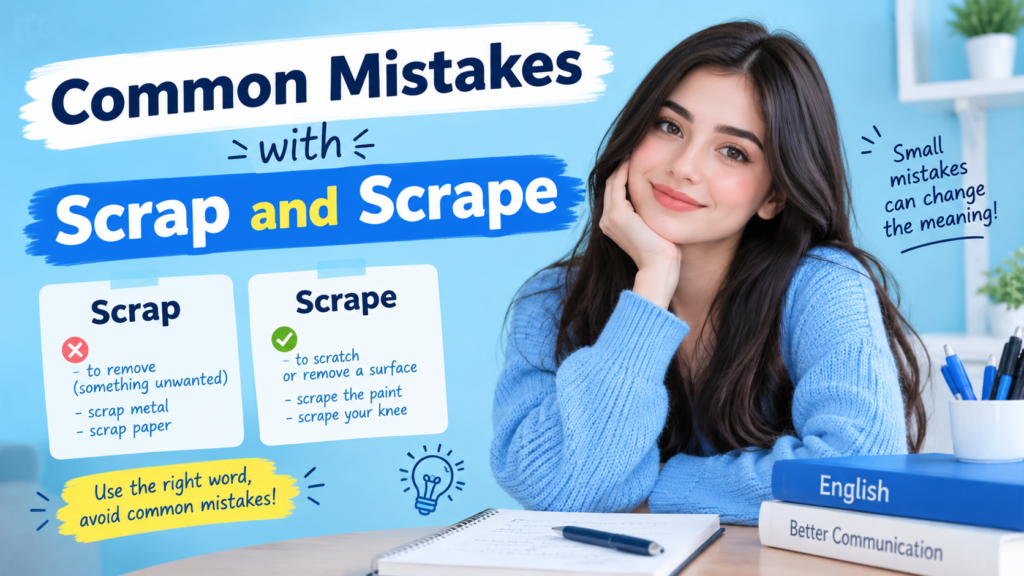
Common Mistakes with Scrap and Scrape
Many writers make the same few errors. Here are the most common ones.
- Writing “scraped knee.” The correct phrase is “scraped knee.”
- Writing “web scrapping.” The correct term is “web scraping.”
- Dropping the double “p.” The past tense of scrap is scrapped, not scraped.
- Adding a double “p” to scrape. The past tense of scrape is scraped.
- Mixing up the meanings. “I scraped the project” is wrong. Use “scrapped.”
| Wrong | Right |
| I scraped my elbow. | I scraped my elbow. |
| We scrapped the idea. | We scrapped the idea. |
| Web scrapping is useful. | Web scraping is useful. |
| She scrapped the old car. | She is scrapping the old car. |
Always read your sentence once more. Ask whether you mean “rub” or “throw away.”
Tips to Remember the Difference Between Scrap and Scrape
A few small tricks can make the difference stick. You do not need to memorize rules. Just use a simple picture in your mind.
Helpful Tips
- Scrape has an “e.” Think of “e” as “erase” or “edge.” You use an edge to scrape.
- Scrap is short. It is a short word for a small piece.
- Check the sound. Long “a” means scrape. Short “a” means scrap.
- Think about the injury. Skin gets scraped, never scrapped.
- Think about money. Metal gets scrapped for cash.
Memory Trick
Here is a simple one: “Scrape has an E for Edge. Scrap has an A for Away.”
When you throw something away, it is scrap. When you use an edge to rub a surface, it is scraped. Say it a few times and it will stay with you.
Real-Life Conversation Examples
Seeing the words in real talk makes them easier to understand. Here are four short conversations.
Example 1
Mia: Why are you limping?
Jake: I fell off my bike. I scraped my knee on the road.
Mia: Ouch! Let me get you a bandage.
Example 2
Boss: Is the new ad plan ready?
Sam: Not really. I think we should scrap it.
Boss: Okay. Let’s start fresh on Monday.
Example 3
Dad: The old fridge finally died.
Lena: Can we sell it for scrap?
Dad: Yes. The yard pays by weight for metal.
Example 4
Chris: The windshield is covered in ice.
Ana: Grab the scraper. You need to scrape it before we leave.
Chris: On it. This will take a few minutes.
Why People Confuse Scrap and Scrape
There are a few clear reasons for the mix-up.
First, the words look nearly the same. They share five of their first six letters. Second, they sound close, especially when people talk fast. Third, both words relate to small, rough actions. They both belong to the world of chores, repairs, and leftovers.
Also, they overlap in real life. When you scrape food off a plate, you create scraps. When you scrape old paint off a chair, the bits are scraps. Because the two ideas often happen together, people blur them in writing.
Spell checkers do not always help either. Both words are real, so the software may not flag the mistake.
Why People Search “Scrap vs Scrape”
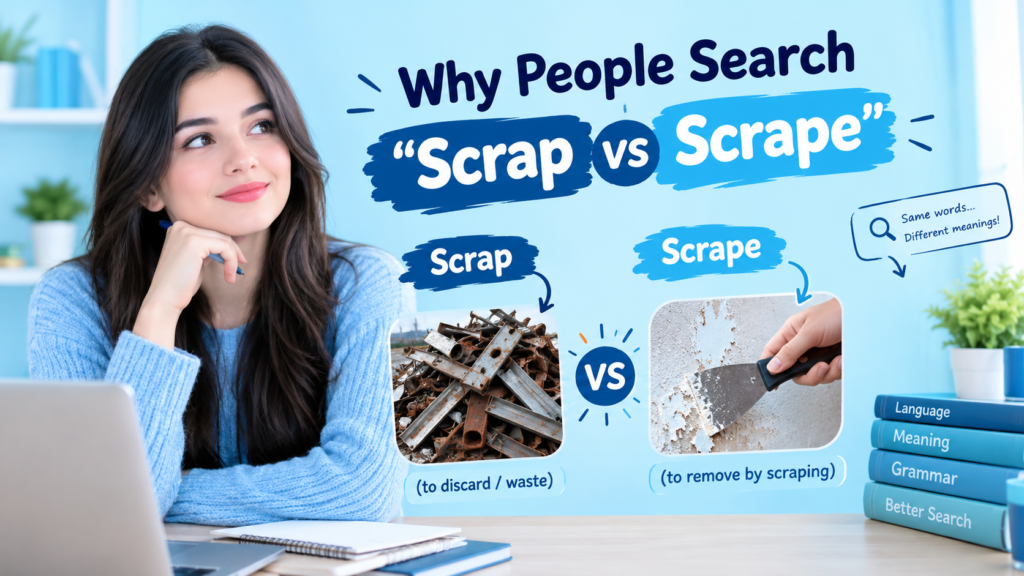
Most people search this phrase for one of four reasons.
- Writing help. Students and writers want to pick the right word.
- Past tense. Many ask whether to write scrapped or scraped.
- Work and tech. Others look up “web scraping” or “scrap metal prices.”
- Everyday life. People also search for things like scraped knees or old cars.
Voice search has made this even more common. People ask their phones, “Is it scrap or scrape?” and they want a quick answer. This guide gives you that answer, plus the detail behind it.
Should You Use Scrap or Scrape?
The answer depends on the meaning you want.
Use scrap if you mean a leftover piece, junk, or to cancel or throw something out. Use scrape if you mean to rub, scratch, or remove a layer from a surface.
Here is a final cheat sheet:
| If You Mean… | Use |
| Cancel a plan | Scrap |
| Sell old metal | Scrap |
| Leftover bits | Scrap |
| Hurt your skin | Scrape |
| Remove paint or ice | Scrape |
| Pull data from a website | Scrape |
When in doubt, picture the action. If something is going away, choose scrap. If something is being rubbed, choose scrape.
Frequently Asked Questions
What is the difference between scrap and scrape?
Scrap means a leftover piece or to throw something away. Scrape means to rub or remove something from a surface.
Is it scraped knee or scrapped knee?
It is “scraped knee.” A scrape is a skin injury caused by rubbing against a rough surface.
What is the past tense of scrap and scrape?
The past tense of scrap is “scrapped,” with a double “p.” The past tense of scrape is “scraped.”
Is it web scraping or web scrapping?
The correct term is “web scraping.” It means collecting data from websites using a program.
Does scrap metal mean the same as scraping metal?
No. Scrap metal means old metal that is sold for recycling. Scraping metal means rubbing a tool across it to remove rust or paint.
Final Thoughts
Scrap and scrape may look like twins, but they have different jobs. Scrap is about leftovers and letting go. Scrape is about rubbing, scratching, and removing. Their past tense forms, scrapped and scraped, also follow different spelling rules.
Once you link each word to a clear picture, the choice gets easy. Use the memory trick, check the sound, and read your sentence once more. With a little practice, you will use both words with confidence in school, work, and daily life.

Noah is a passionate content writer and language enthusiast who enjoys making difficult words, phrases, and text meanings easy to understand. He creates clear, simple, and useful articles with practical examples to help readers improve their vocabulary and everyday language skills.