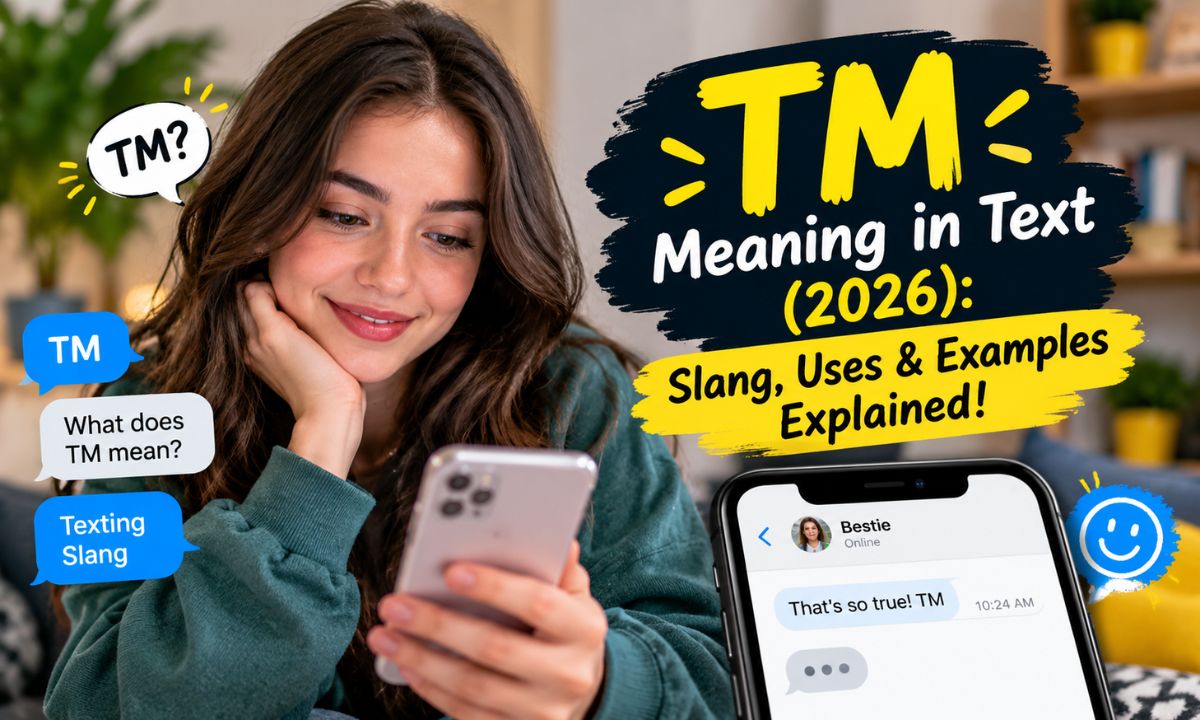
You open a chat and see a short message that ends with “tm.” You pause. Does it mean “text me”? Does it mean “trust me”? Or is it something else?
You are not alone. Many people in the USA get confused by this tiny abbreviation. The reason is simple. TM has more than one meaning. The right answer depends on who sent it, where it was sent, and what the message is about.
This guide explains TM in plain English. You will learn the most common meanings, see real examples, and find out when to use it and when to skip it. By the end, you will read TM like a pro.
Quick Overview Table
Here is a fast look at the meaning of TM in different places. Use this table if you are in a hurry. The rest of the article explains each row in detail.
| Search Term | Most Likely Meaning | Example |
| TM meaning in text | Text me, trust me, or trademark | “Tm when you land.” |
| What do TM mean in text | Usually “text me” | “Tm if you need a ride.” |
| What is TM in texting | A short form with several meanings | “Tm, I got this.” |
| What does TM mean in text | Depends on the chat | “Tm later.” |
| TM meaning UK slang | Text me | “Tm me the address.” |
| TM meaning Snapchat | Text me or take me | “Tm on here or on my phone.” |
| TM meaning texting | Text me or trust me | “Tm, it will work.” |
| TM meaning in log | Time, timer, or a system tag | “TM: 14:32:10” |
| TM meaning on Instagram | Text me or trademark | “Brand name TM” in a bio |
| TM meaning in medical | Tympanic membrane (eardrum) | “TM is red and bulging.” |
| TM meaning in company | Trademark or team member | “Our logo is a TM.” |
| TM meaning in work | Team member or territory manager | “Every TM must attend.” |
The short version is this. In casual chats, TM most often means “text me.” In business, it often means “trademark” or “team member.” In a doctor’s office, it means “tympanic membrane.”
What Does TM Mean in Text?

In a text message, TM is a short form. People use it to save time. The most common meaning is “text me.” The second most common is “trust me.” A third meaning, “trademark,” shows up in brand talk and jokes.
TM is not a formal word. You will not see it in school essays or business emails. It lives in quick chats, comments, and captions. That is why the meaning can change from one conversation to the next.
Think of TM like a small tool. One tool, many jobs. You just need to check the setting to know which job it is doing.
Below, we break down the meaning by platform, region, and field.
TM Meaning UK Slang
In the UK, TM usually means “text me.” A friend might write, “Tm when you get to the station.” It is quick and friendly.
Some UK users also write “txt me” or “msg me.” TM sits in the same family. It is short, casual, and easy to type on a phone.
It is also worth knowing that UK teens sometimes use TM for “trust me” when they want to sound sure. For example, “Tm, it is going to be a good night.”
Tm Meaning Snapchat
On Snapchat, TM most often means “text me.” Snapchats vanish fast. Some users prefer to move to normal texting. So they drop a quick “tm” and share a number.
It can also mean “trust me” in a caption. For example, a snap of a sunset might say, “Best view in town, tm.”
If you are not sure, ask. A short “tm as in text me?” clears things up in seconds.
Tm Meaning Texting
In plain texting, TM is flexible. Here are the main meanings you may run into:
- Text me: “Tm when you are free.”
- Trust me: “Tm, I know a shortcut.”
- Tomorrow: “See you tm.” (This is rare. Most people write “tmrw” or “2moro.”)
- Trademark: “My brand name TM is now live.”
- To me: “It looks fine tm.” (Also rare.)
The first two are by far the most common in the USA.
TM Meaning in Log
In tech and system logs, TM is not slang. It is often a label. It may stand for “time,” “timer,” or “time marker.” Some systems also use it for “transaction manager” or “task manager.”
Here is a simple example of a log line:
TM: 2026-03-14 09:15:42 | status=OK
In that line, TM points to a timestamp. The exact meaning depends on the software. If you see TM in a log, check the documentation for that tool. Do not guess.
TM Meaning on Instagram
On Instagram, TM can show up in bios, captions, and DMs. In DMs, it often means “text me.” In bios, it can mean “trademark.” Small business owners add a TM sign next to a brand name to show that they claim it.
You may also see it in jokes. For example, “Monday blues TM.” The poster is pretending that the phrase is their own brand. It is a playful use of the trademark idea.
Tm Meaning in Medical
In medicine, TM often means “tympanic membrane.” That is the eardrum. A doctor may write, “TM clear” or “TM bulging.” This note describes what the doctor saw during an ear exam.
TM can also mean “transcendental meditation” or “temporomandibular” in some settings, such as TMJ. Still, “tympanic membrane” is the most common in clinical notes.
If you see TM on a medical chart, ask your provider. Never self-diagnose from an abbreviation.
Read More: BBW Meaning in Text
TM Meaning in Company
In a company setting, TM usually means one of two things:
- Trademark: A symbol (™) that shows a business claims a name, logo, or slogan.
- Team member: A friendly word many US companies use for employees.
A trademark with ™ is not the same as a registered trademark with ®. The ™ symbol means a brand is claiming rights. The ® symbol means the claim is officially registered with the United States Patent and Trademark Office.
Tm Meaning in Work
At work, TM may mean “team member.” Stores and restaurants across the USA use it all the time. For example, “All TMs must clock in by 8 a.m.”
It may also stand for “territory manager,” “technical manager,” or “test manager.” The job type decides the meaning. If your boss sends a message with TM in it, check the context or just ask.
TM Meaning in Chat Conversations
Chat apps are where TM is used the most. People type fast. They want short replies. TM fits well in that rhythm.
The three big meanings in chat are “text me,” “trust me,” and “trademark.” Each one has its own tone and use. Let us look at them one by one.
TM as “Text Message”
Sometimes TM is used as a short form for “text message.” This is less common than “text me,” but it does happen. A person might say, “Send me a tm when you arrive.”
Here are a few examples:
- “Got your time. Thanks!”
- “I will send a tm after class.”
- “Check your tm, I sent the link.”
Most people say “text” or “msg” instead. So if you see this meaning, it is likely from a person who likes very short words.
A quick tip: if the sentence still makes sense when you swap in “text me,” go with that. It is the safest guess.
TM as “Trust Me”
“Trust me” is the second most common meaning. People use it to sound sure or to calm a friend down.
Examples:
- “Tm, the movie is worth it.”
- “Tm, I checked the map twice.”
- “Just tm on this one.”
The tone can be serious or playful. It all depends on the emoji and the words around it. A wink face makes it a joke. A plain sentence makes it a promise.
Be careful, though. “Trust me” can also sound pushy. If you use TM too often, friends may start to doubt you.
TM as “Trademark”
TM also stands for “trademark.” In writing, it appears as a small raised symbol: ™. It tells people that a word, logo, or phrase is being used as a brand.
In chat, people type “TM” because the symbol is hard to find on a phone. They may write, “Check out my new brand, SunnyCup TM.”
It also shows up in memes. A user might write “my sleep schedule TM” as a joke. They treat their own habit like a famous product. It is funny because it is over the top.
Here is a quick comparison:
| Meaning | Where You See It | Tone |
| Text me | Personal chats, DMs | Casual |
| Trust me | Chats, captions | Casual or playful |
| Trademark | Brands, bios, memes | Business or funny |
| Text message | Rare, short chats | Casual |
TM Meaning on Social Media Platforms

Social media apps each have their own style. The same two letters can mean different things to each one. Here is how TM tends to work on the big four in the USA.
TM on Snapchat
On Snapchat, TM means “text me” most of the time. The app is fast and casual. Users like to move to a normal text thread when they want a longer talk.
Example: “Tm instead, my snaps are slow.”
It can also be used in a story caption as “trust me.” Read the picture and the words together. They usually give the answer.
TM on Instagram
Instagram has two main uses. In DMs, TM is mostly “text me.” In public posts, TM is often “trademark” or a joke about it.
Creators and small shops like to add ™ to a name. It signals that the name is theirs. Fans copy this style in comments to be funny.
Example comment: “That outfit is giving main character TM.”
TM on WhatsApp
WhatsApp is a text-first app. So TM is most often “text me” or a casual way to say “trust me.” In group chats, you may also see it in work talk as “team member.”
Because WhatsApp is popular worldwide, you may see TM used by friends from other countries. Some use it as a short form in their own language. If a message looks odd, ask what they meant.
TM on TikTok
TikTok is where TM gets playful. Creators use it in captions and comments to mock the idea of owning a phrase. For example, “Girl dinner TM” or “Soft life TM.”
It can also mean “trust me” in video captions. A cooking video might say, “Tm, this hack works.”
Here is a quick platform summary:
| Platform | Top Meaning | Other Meaning |
| Snapchat | Text me | Trust me |
| Text me (DMs) | Trademark (bios, jokes) | |
| Text me | Team member | |
| TikTok | Trademark joke | Trust me |
Why People Use TM in Texting
People use TM for a few simple reasons. First, it saves time. Two letters are faster than eight.
Second, it feels casual. A short word makes a chat feel relaxed. Friends do not want to type long lines all day.
Third, it fits small screens. Phones have tiny keyboards. Short forms cut down on typos.
Fourth, it can be funny. The trademark joke only works with TM. It gives a bit of humor to a plain sentence.
Here are the main reasons in a list:
- Speed and ease of typing
- A relaxed, friendly tone
- Less effort on small keyboards
- Humor and meme culture
- A sense of belonging to a group that “gets it”
That last point matters. Slang builds a bond. When two friends use the same short forms, the chat feels more personal.
Understanding TM Based on Context
Context is the key to reading TM. Look at who sent the message. Look at the app. Look at the topic. These three clues solve most puzzles.
Here are some simple clues you can use:
- Is it a request? If the sentence asks you to do something, TM likely means “text me.”
- Is it a promise? If the sentence sounds like a guarantee, TM likely means “trust me.”
- Is it about a brand? If you see a name or logo, TM likely means “trademark.”
- Is it about a job? If the talk is about shifts or staff, TM may mean “team member.”
Try the swap test. Replace TM with each meaning and read the sentence out loud. The one that sounds natural is usually right.
Example: “Tm when you are home.” Swap in “text me.” It works. Swap in “trust me.” It sounds odd. So the meaning is clear.
When in doubt, ask. No one will mind. A quick “what does tm mean here?” is better than a wrong guess.
The Evolution of TM in Digital Communication
TM did not start as slang. It began as a legal mark. The ™ symbol has been used for decades to show that a business claims a name. That use is still strong today.
When texting became popular in the early 2000s, people began to shorten words. Typing was slow on number keypads. Short forms like “u,” “ur,” and “txt” took over. TM fit into this trend as “text me.”
Later, smartphones and social apps changed the game. Full keyboards made typing easier. But habits stayed. People kept their short forms because they were fast and fun.
Then meme culture arrived. Users began to add TM to everyday phrases as a joke. This gave the letters a brand new life.
Here is a simple timeline:
| Era | How TM Was Used |
| Before 2000 | Mostly a legal trademark symbol |
| 2000s | “Text me” in SMS chats |
| 2010s | “Trust me” and “text me” on social apps |
| 2020s | Meme-style “trademark” jokes on TikTok and Instagram |
In 2026, all of these uses live side by side. That is why the meaning can feel tricky.
How Context Changes the Meaning of TM

The same two letters can point to very different ideas. Let us look at how the setting changes the meaning.
Imagine five people send you a message with TM:
- Your friend writes, “Tm when you land.” That means “text me.”
- Your cousin writes, “Tm, it is a good deal.” That means “trust me.”
- A shop owner writes, “Our slogan is now TM.” That means “trademark.”
- Your manager writes, “All TMs on the floor.” That means “team members.”
- A nurse writes, “TM looks normal.” That means “tympanic membrane.”
Same letters. Five different worlds.
Here is a handy guide:
| Setting | Likely Meaning |
| Friends chatting | Text me |
| Giving advice or a promise | Trust me |
| Branding and marketing | Trademark |
| Retail or restaurant work | Team member |
| Doctor’s notes | Tympanic membrane |
| Software logs | Time or timer |
The more formal the setting, the less likely TM is slang. In a clinic or a legal document, it is a proper term. In a group chat, it is probably casual.
TM in Modern Messaging Culture
Modern messaging is fast, short, and visual. People mix words, emojis, GIFs, and voice notes. In this mix, short forms like TM fit right in.
TM also shows how language keeps changing. Young people in the USA create new uses all the time. Some stay for years. Others fade in a few months.
The trademark joke is a good sample of modern humor. It is light, self-aware, and easy to copy. Anyone can add TM to a phrase and make people smile.
Brands have noticed too. Some use TM in playful ads to sound like real people. When done well, it feels fresh. When done badly, it feels forced.
Here are a few trends in messaging culture today:
- Shorter replies, faster talk
- More inside jokes
- Mixing formal terms with funny use
- Slang that spreads through short videos
TM is a small part of that big picture. But it shows how a simple symbol can turn into a social tool.
Importance of Understanding TM
Why does it matter to know what TM means? Because small mix-ups can cause real problems.
Imagine your boss writes, “TM me the file.” If you read it as “trust me,” you may do nothing. A missed deadline follows. Or imagine you reply “tm” to a friend and they think you are making a joke when you meant to promise something.
Understanding TM helps you in three ways:
- Clear talk: You avoid confusion and wrong replies.
- Better trust: You show that you care about what others mean.
- Smart safety: You can spot scams that use short forms to rush you.
That last point is real. Scammers sometimes write, “Tm me now, urgent.” They want you to move to a private chat quickly. If a stranger pushes you to text them at once, slow down. Do not share personal data.
Knowing the slang is a simple way to stay sharp online.
Role of TM in Online Conversations
In online talk, TM plays a few useful roles.
First, it moves a chat to a new place. “Tm” can mean “let us continue in text.” This is common when a chat starts on a public app and needs privacy.
Second, it adds trust. “Tm” works as a quick way to back up a claim. It is short and warm.
Third, it adds humor. In memes and comments, TM turns a normal phrase into a mock brand.
Fourth, it protects ideas. In business posts, ™ lets creators claim a name before they register it.
Here is a short list of roles:
- A call to action (text me)
- A promise (trust me)
- A joke (trademark meme)
- A claim (brand name)
One tiny abbreviation, many jobs. That is why TM stays popular.
When to Use TM
Use TM when the setting is casual and the other person will understand it. Here are good times to use it:
- Chatting with close friends or family
- Writing quick replies in DMs
- Posting a funny caption on TikTok or Instagram
- Marking a brand name in a social bio with ™
- Replying fast when you are on the go
Here are a few ready-to-use examples:
- “Tm when you get home.”
- “Tm, this pizza place is great.”
- “Monday mood TM.”
A simple rule helps: if you would say it out loud to a friend, you can type it. If not, write the full words.
Also, make sure your friend knows the slang. If they are older or new to online chat, spell it out the first time. It keeps things friendly.
When NOT to Use TM
Skip TM in formal or serious messages. Here are times to avoid it:
- Emails to a boss, teacher, or client
- Job applications and resumes
- Legal or school documents
- Messages with people who may not know the slang
- Urgent or safety messages where clarity matters
In those cases, write the full phrase. “Please text me” is clear and polite. “Tm” may look lazy or confusing.
Also avoid using TM as a trademark symbol when you have not earned the right. Putting ™ on a name is a claim. It is fine for your own brand. But do not use it on someone else’s name or logo.
And never use ® unless the mark is officially registered. That is a legal line. Misusing it can cause trouble.
Here is a quick table:
| Situation | Use TM? | Better Option |
| Text to a friend | Yes | “Tm later” |
| Email to a manager | No | “Please text me” |
| Instagram caption | Yes | “Weekend vibes TM” |
| Job application | No | Write full words |
| Medical form | Only if you know the term | Ask the provider |
Similar Slang Terms to TM
TM has plenty of cousins in the slang world. Here are some that people in the USA use often:
| Slang | Meaning | Example |
| DM | Direct message | “DM me the details.” |
| PM | Private message | “PM me your number.” |
| TXT | Text | “Txt me later.” |
| TBH | To be honest | “TBH, I loved it.” |
| FR | For real | “FR, that was wild.” |
| NGL | Not gonna lie | “NGL, I am tired.” |
| TMRW | Tomorrow | “See you tmrw.” |
| TTYL | Talk to you later | “TTYL, bye!” |
| IDK | I do not know | “IDK what to wear.” |
| ILY | I love you | “ILY, mom.” |
If you want a strong “trust me” feel, you can also use “no cap” or “fr fr.” If you want a “text me” feel, “DM me” and “hit me up” work well.
Learning these terms helps you read chats with ease. You will also sound more natural when you reply.
Why TM Is Trending
TM is trending for a few clear reasons.
First, short videos spread slang fast. A single viral post can make millions of people copy the same joke. The trademark meme is a strong example.
Second, people love humor that pokes fun at business talk. Adding TM to a normal phrase mocks the idea of owning everything. It feels clever and light.
Third, more people run side businesses online. Small sellers on Instagram and TikTok use ™ to protect their names. That puts the symbol in front of more eyes.
Fourth, texting is still the main way people talk. As long as people type on phones, short forms will stay alive.
Fifth, curiosity drives search. When people see TM and do not know it, they look it up. That keeps the topic hot on Google, especially in voice search.
In short, TM trends because it is useful, funny, and easy to share.
Frequently Asked Questions
What does TM mean in text?
In most texts, TM means “text me.” It can also mean “trust me” or “trademark,” depending on the chat.
What is TM in texting on Snapchat?
On Snapchat, TM usually means “text me.” Some users also use it to say “trust me” in captions.
What does TM mean on Instagram?
In Instagram DMs, TM often means “text me.” In bios and captions, it usually means “trademark” or is used as a joke.
What does TM mean at work?
At work, TM commonly means “team member.” It can also mean “territory manager” or “technical manager,” depending on the job.
What does TM mean in medical notes?
In medical notes, TM usually stands for “tympanic membrane,” which is the eardrum.
Final Thoughts
TM looks small, but it carries many meanings. In texts, it often means “text me” or “trust me.” In business, it means “trademark” or “team member.” In medicine, it means “tympanic membrane.” In logs, it can point to time. The trick is to read the context and use the swap test.
Use TM with friends and in casual posts. Skip it in formal messages. When you are unsure, just ask. A quick question is better than a wrong guess, and it keeps every chat clear and friendly.

Noah is a passionate content writer and language enthusiast who enjoys making difficult words, phrases, and text meanings easy to understand. He creates clear, simple, and useful articles with practical examples to help readers improve their vocabulary and everyday language skills.