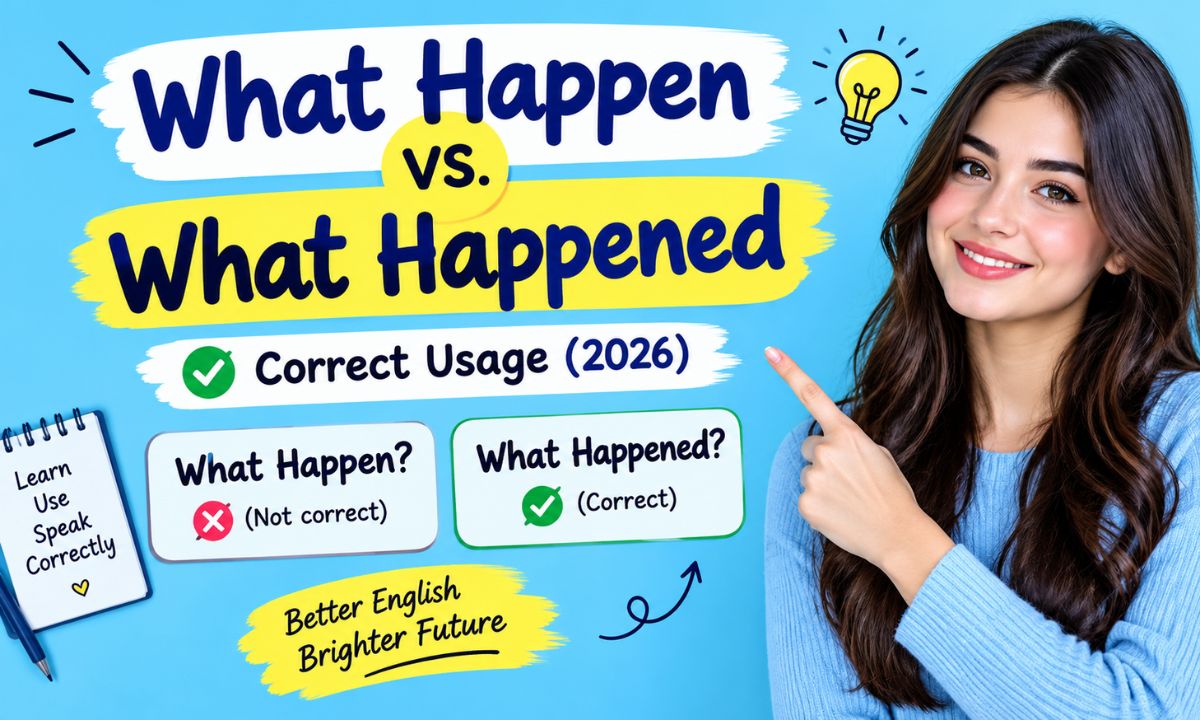
Many English learners get stuck on this small question. Should you say “what happen” or “what happened”? The two phrases look almost the same. But only one of them is right in most cases.
This guide explains the difference in simple words. You will see the grammar rule, clear examples, a short quiz, and easy memory tricks. By the end, you will know exactly which form to use in speaking, writing, and exams.
If you have ever paused before sending a text or an email, this article is for you. Let’s clear it up once and for all.
Which Is Correct: “What Happen” or “What Happened”?
The short answer is simple. “What happened” is correct in almost every situation. It is the standard form used in American English.
Use “what happened” when you ask about something that is already over. It works for small events and big ones. It works in casual talk and in formal writing.
Here are a few quick examples:
- What happened to your phone?
- What happened at the meeting today?
- What happened after the storm?
In each sentence, the event is finished. That is why the past tense “happened” is the right choice.
“What happen” sounds natural to some people. You may hear it in songs, movies, or fast speech. But in standard grammar, it is usually a mistake. If you are asking about the past, you need the past tense.
| Phrase | Correct? | Why |
| What happened? | Yes | Past tense for a finished event |
| What happen? | Usually no | Missing the past tense ending |
What Does “Happen” Mean in English?
“Happen” is a verb. It means to take place or to occur. When something happens, an event or situation comes into being.
You use “happen” to talk about events, accidents, changes, and surprises. Most of the time, you do not control what happens. It just takes place.
Here is how “happen” works in different sentences:
- Accidents can happen to anyone.
- I hope nothing bad happens tonight.
- Things happen for a reason, some people say.
“Happen” is also used in a few common phrases. For example, “happen to” means by chance. If you say, “I happen to know her,” you mean you know her by coincidence. Another one is “happen upon,” which means to find something by luck.
Understanding what happen meaning is easy once you see it as a verb. It is the base form. It has no past tense ending. That is the key point for this whole topic.
Here are the main forms of the verb:
| Form | Word | Example |
| Base form | happen | Accidents happen. |
| Third person singular | happens | It happens every day. |
| Past tense | happened | It happened yesterday. |
| Past participle | happened | It has happened before. |
| Present participle | happening | It is happening now. |
Notice that “happen” does not need an object. You do not “happen” to something. Things just happen. This kind of verb is called intransitive. It also does not work in the passive voice. You cannot say “it happened.” That is a common error, and it is worth remembering.
What Is “Happened”? (Past Tense Explained Clearly)
“Happened” is the past tense of “happen.” It tells us that an event took place earlier. The action is finished.
“Happen” is a regular verb. That makes it easy. To make the past tense, you just add “-ed.” So “happen” becomes “happened.” There is no spelling change and no special rule.
Look at these simple examples:
- The accident happened last night.
- Something strange happened at school.
- It all happened so fast.
“Happened” also works as a past participle. You use it with helper words like “has,” “have,” and “had.” For example, “What has happened here?” or “I wish it had never happened.”
Do not confuse “happened” with “happening.” The word “happening” shows that something is going on right now. For example, “What is happening?” asks about the present moment. “What happened?” asks about the past.
Here is a quick timeline to help:
| Time | Question | Meaning |
| Past | What happened? | The event is over |
| Present | What is happening? | The event is going on now |
| Future | What will happen? | The event has not come yet |
How do you say it out loud? The “-ed” in “happened” sounds like a soft “d.” It is pronounced “HAP-und.” It has two syllables, not three. Many learners add an extra sound, but you do not need one.
Why “What Happened” Is the Correct Form

There are two clear reasons. The first is tense. The second is sentence structure.
When you ask about a finished event, English needs the past tense. The event already took place. So the verb must show that. “Happened” does this job. “Happen” does not.
The second reason is how questions work. In the question “What happened?”, the word “what” is the subject. It stands for the thing that took place. The verb “happened” comes right after it. There is no helper verb like “did” in this case.
This is a special point. Many learners think they need “did” in every past question. They might say “What did happen?” That is possible, but it adds emphasis. The normal form is simply “What happened?”
Compare these:
- What happened to the car? (normal and natural)
- What did happen to the car? (stronger, used for emphasis)
- What happen to the car? (incorrect)
So when people search what happen vs what happened grammar, the answer is clear. The past tense is needed. And “what happened” is the clean, standard way to say it.
This phrase is also very common in American English. You hear it in news reports, in movies, and in daily chats. Because it is so common, using it correctly helps you blend in and sound natural.
Read More: Simpler or More Simple
Why “What Happen” Is Usually Incorrect
“What happen” breaks a basic rule. It uses the base form of the verb in a place where the past tense belongs. The sentence feels unfinished.
Let’s look at it closely. If you ask, “What happen to your hand?”, you are talking about a past injury. But “happen” has no past marker. A listener may understand you. Still, the grammar is wrong.
There are a few reasons why people make this mistake:
- Fast speech. In quick talk, the “-ed” sound can almost disappear.
- Native language influence. Some languages do not change the verb for tense.
- Dialects and slang. Some informal speech patterns drop the ending.
- Pop culture. Songs and memes sometimes use “what happen” on purpose.
The “-ed” ending in “happened” sounds like a soft “d” or “t.” It is easy to miss. But in writing, you cannot hide it. A missing “-ed” stands out right away.
If you want to sound clear and professional in the United States, always use “what happened.” It avoids confusion. It also shows you know the rules of standard English.
Does it mean people who say “what happen” are not smart? Not at all. Grammar habits come from where we grow up and which languages we speak. The goal is not to judge anyone. The goal is to know the standard form so you can choose it when it matters.
Grammar Rule: When to Use Past Tense in Questions
Here is the main rule. Use the past tense when you ask about an event that is finished. That is the core of the lesson.
But how you build the question depends on the sentence. There are two main patterns in English.
Pattern 1:
When “what” is the subject. In this case, you do not need “did.” The verb takes the past tense directly.
- What happened?
- What broke?
- What changed?
Pattern 2:
When “what” is the object. Here you need “did,” and the main verb goes back to its base form.
- What did you see?
- What did she say?
- What did they buy?
Notice something important. In Pattern 2, the verb is in the base form. It says “see,” not “saw.” This is because “did” already carries the past tense.
Now you can see why “what happened” has no “did.” The word “what” is the subject, so the verb stands alone in the past form.
Here is a summary table:
| Situation | Pattern | Example |
| “What” is the subject | What + past verb | What happened? |
| “What” is the object | What + did + subject + base verb | What did you do? |
| Present event | What + is/are + verb-ing | What is happening? |
| Future event | What + will + base verb | What will happen? |
Keep this table handy. It solves many past tense question problems, not just this one.
A quick test can help. Try answering the question with a noun. “What happened?” “The power went out.” The answer is the subject of the action. Now try “What did you see?” “I saw a bird.” The answer is the object. This simple check shows which pattern to use.
Can “What Happen” Ever Be Correct?
There are a few rare cases where “what happen” can appear. But these are special situations. They are not standard grammar.
Case 1:
After helper verbs: The base form “happen” is correct in some other questions. For example, “What will happen next?” or “What can happen if you skip sleep?” Here, “will” and “can” are helper verbs. They need the base form.
Case 2:
Plural subjects in the present: You might say, “What things happen at night?” Here, “things” is the subject and “happen” is correct for a plural subject.
Case 3:
Dialect and casual speech: Some English speakers drop the “-ed” in relaxed talk. You may hear it in certain regional dialects or in song lyrics. This is a style choice, not a rule.
Case 4:
Quoting or naming: A song, show, or book title might use “What Happen” on purpose. In that case, you keep the original wording.
So if someone says “what happen is correct,” they are only partly right. It is correct in some helper verb sentences. But as a standalone question about the past, it is not.
Here is a quick guide:
| Sentence | Correct? | Reason |
| What happen to you? | No | Needs past tense |
| What will happen next? | Yes | “Will” needs base form |
| What can happen here? | Yes | “Can” needs base form |
| What happened to you? | Yes | Past event |
Common Mistakes to Avoid
Even strong English speakers slip up on this topic. Here are the most common errors and how to fix them.
Mistake 1:
Dropping the “-ed:” Wrong: What happen yesterday? Right: What happened yesterday?
Mistake 2:
Adding “did” and “-ed” together: Wrong: What did happened? Right: What happened? or What did happen?
This is a double past tense. Use only one past marker.
Mistake 3:
Mixing up “happen” and “happening:” Wrong: What happen now? Right: What is happening now?
Mistake 4:
Using the past form after “will” or “can:” Wrong: What will happened next? Right: What will happen next?
Mistake 5:
Forgetting the “-s” for third person present: Wrong: It happens every day. Right: It happens every day.
Mistake 6:
Using the passive voice: Wrong: The accident happened last week. Right: The accident happened last week.
Here is a mistake and fix table for easy review:
| Wrong | Right |
| What happen to him? | What happened to him? |
| What did happened? | What happened? |
| What will happened? | What will happen? |
| It happen often. | It happens often. |
| What happen now? | What is happening now? |
| It was happened. | It happened. |
A simple trick helps here. Check for helper verbs first. If you see “will,” “can,” “did,” or “would,” use the base form “happen.” If there is no helper verb and the event is over, use “happened.”
Real-Life Examples of “What Happened”
Seeing a phrase in real situations makes it stick. Here are common examples from everyday life in the United States.
At home:
- What happened to the dishes? They were clean this morning.
- What happened to the Wi-Fi? It stopped working.
At work:
- What happened in the meeting? I missed it.
- What happened to the report I sent you?
At school:
- What happened in class today?
- What happened to your homework?
With friends:
- What happened last night? You looked tired.
- What happened to your plans for the weekend?
In the news:
- What happened at the game last night?
- What happened during the storm?
Now look at how the phrase can show different feelings. Tone changes the meaning.
| Tone | Example | Feeling |
| Worried | What happened to your arm? | Concern |
| Curious | What happened after that? | Interest |
| Upset | What happened to our deal? | Frustration |
| Surprised | What happened here? | Shock |
You can also use “what happened” as a full sentence. For example, if a friend looks sad, you can simply ask, “Hey, what happened?” It is short, kind, and natural.
The phrase also works inside longer sentences. These are called embedded questions. In them, the word order stays the same, and you still use the past tense.
- I don’t know what happened.
- Can you tell me what happened?
- She asked what happened to the car.
Notice there is no question mark in the first and third examples. They are statements, not direct questions.
What Happen vs What Happened in Daily Conversations
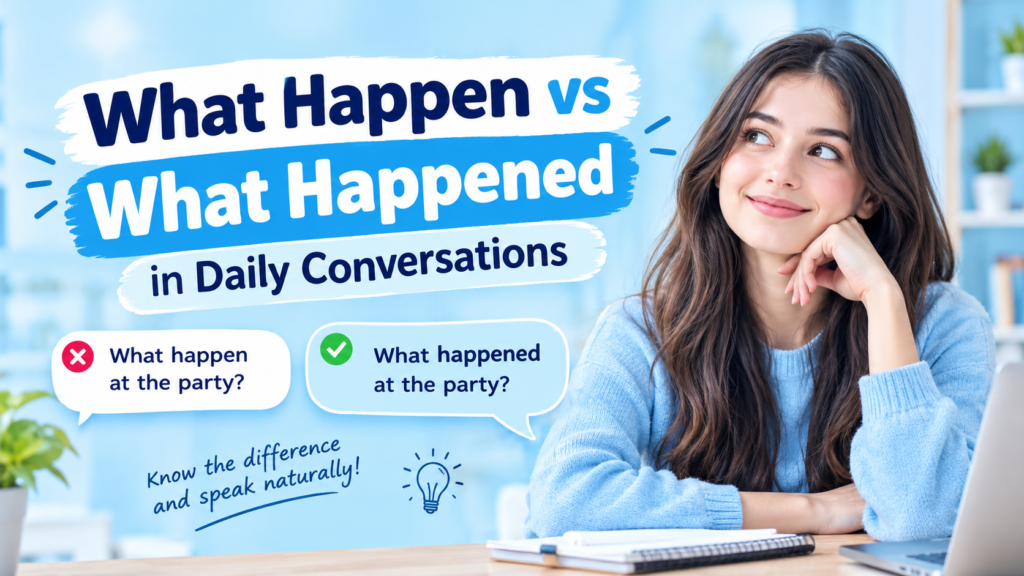
In daily talk, people speak fast. The “-ed” ending can get soft. That is why “what happen” sometimes slips out. But the better habit is to say it fully.
In the United States, “what happened” is the common form. You will hear it at home, at work, and in public. It is clear and friendly.
Here are some short chats to show it in action:
Chat 1
“You’re late. What happened?”
“My car broke down on the highway.”
Chat 2
“What happened to your phone?”
“I dropped it in the sink.”
Chat 3
“What happened at practice?”
“The coach canceled it because of rain.”
Notice how simple and warm these sounds are. The phrase works in almost any chat.
Here are some useful tips for speaking:
- Say the “-ed” ending lightly, but clearly. It sounds like “t” or “d.”
- Link the word to the next one. “What happened to” flows as one phrase.
- Slow down a little if you are not sure.
- Listen to native speakers in shows and podcasts.
If you hear “what happen” in casual talk, do not copy it. Stick to the standard form. It will serve you well in every setting.
Phone calls and voice messages are a good place to practice. You cannot rely on body language there. A clear “what happened” helps the other person understand you the first time.
What Happen vs What Happened in Writing
Writing is different from speaking. In writing, every letter shows. There is no way to blur the ending. So accuracy matters more.
In emails, reports, and essays, always use “what happened” for past events. A missing “-ed” can make you look careless. It can also confuse readers.
Here are examples for different types of writing:
Email: “Hi Sarah, I wanted to ask what happened with the order. It has not arrived.”
Report: “The team reviewed what happened during the system outage.”
Text message: “Omg what happened?? Are you okay?”
Essay: “The article explains what happened before the war began.”
Even in texts, the correct form is best. It takes no extra time. And it keeps your message clear.
Here are some writing tips:
- Check your verb tense in every question.
- Read your sentence out loud before sending.
- Use spell check, but do not rely on it alone. “What happen” is a grammar issue, so some tools may miss it.
- Keep your tense steady. Do not jump between past and present without a reason.
Good writing builds trust. One small fix like “happened” can make your message stronger.
For business writing, the phrase is also useful in a polite way. You might write, “Could you explain what happened?” This sounds calm and professional. It invites a clear answer without blaming anyone.
What Happen vs What Happened for Students and Exams
Students often see this topic on English tests. It appears in grammar sections, fill in the blank tasks, and error correction questions. Knowing the rule can save you easy points.
Here is how it is usually tested:
Fill in the blank:
“What ______ to your bag?” (happen / happened)
Answer: happened
Error correction:
“What happen yesterday at the party?” Correct: “What happened yesterday at the party?”
Sentence choice:
Which is correct? (a) What will happened next? (b) What will happen next?
Answer: (b)
Here is a short what happen vs what happened quiz to test yourself. Try it before checking the answers.
- What ______ to the cake? It is gone.
- What will ______ if we leave now?
- I do not know what ______ last night.
- What ______ at the store yesterday?
- What can ______ if you skip breakfast?
Answers:
- happened
- happen
- happened
- happened
- happen
Did you notice the pattern? Past time words like “yesterday” and “last night” call for “happened.” Helper verbs like “will” and “can” call for “happen.”
Exam tips:
- Look for time clues in the sentence.
- Check for helper verbs before you choose.
- Read the full sentence in your head.
- Do not add both “did” and “-ed.”
- Eliminate wrong choices first if you feel unsure.
With a little practice, these questions become very easy. Try making your own quiz questions too. Writing them helps you learn faster than only reading.
Quick Comparison: What Happen vs What Happened
This table sums up the main differences. Use it as a fast reference.
| Feature | What Happen | What Happened |
| Tense | Base form | Past tense |
| Standard grammar | Usually incorrect alone | Correct |
| Use for finished events | No | Yes |
| Use after “will” or “can” | Yes (as “what will happen”) | No |
| Common in formal writing | No | Yes |
| Common in casual slang | Sometimes | Yes |
| Best for exams | Only with helper verbs | Yes, for past events |
Here is another view based on time.
| When did it take place? | Correct Form | Example |
| Already finished | What happened | What happened last week? |
| Going on now | What is happening | What is happening outside? |
| Not yet | What will happen | What will happen tomorrow? |
| General fact | What happens | What happens when ice melts? |
The main idea is easy. Match the verb to the time of the event. If it is over, use “happened.”
Tips to Remember the Correct Usage
Rules are easier to keep when you have simple tricks. Here are some that really work.
Tip 1: Look for “past” clues: Words like “yesterday,” “last week,” “earlier,” and “ago” point to the past. Use “happened” with them.
Tip 2: Check for helper verbs: If you see “will,” “can,” “could,” “would,” “should,” or “did,” use the base form “happen.”
Tip 3: Think “ed means ended:” The “-ed” ending tells you the event has ended. If the event is done, add “-ed.”
Tip 4: Say it out loud: Say “What happened?” a few times. The right form soon sounds natural to your ear.
Tip 5: Use a sticky note: Write “What happened = past” and place it on your desk. Small reminders work well.
Tip 6: Practice with real life: Each day, ask yourself a “what happened” question about your day. For example, “What happened at work today?” This builds the habit.
Tip 7: Read and listen often: Watch American shows, read news, and listen to podcasts. You will hear “what happened” again and again.
Here is a simple memory chart:
| Clue | Use |
| Yesterday, last night, earlier | happened |
| Will, can, could, would | happen |
| Now, right now, currently | is happening |
| Every day, always, often | happens |
Why Using “What Happened” Improves Your English

Small grammar fixes make a big difference. Using “what happened” correctly shows that you understand verb tenses. This is one of the most important skills in English.
First, it makes you clear. Your listener knows right away that you mean a past event. There is no guesswork.
Second, it builds trust. In school, at work, and in daily life, people notice how you speak and write. Correct grammar makes a strong first impression.
Third, it helps you master other past tense questions. Once you understand this one, similar questions get easier. You will handle “What changed?”, “What broke?”, and “What went wrong?” with ease.
Here are the main benefits:
- Better clarity in speech and writing
- Higher scores on tests and quizzes
- More confidence when you talk with native speakers
- Stronger writing in emails, essays, and reports
- A good base for learning other tenses
English can feel hard at times. But small wins add up. Each correct phrase moves you closer to fluent, natural English. And “what happened” is a great place to start.
Frequently Asked Questions
Which is correct, “what happen” or “what happened”?
“What happened” is correct for past events. “What happen” is usually wrong unless a helper verb like “will” or “can” comes before it.
What does “what happened” mean?
“What happened” asks about an event that already took place. It means “what took place?” or “what went on?”
Can I say “what happen” in casual speech?
Some people do informal talk, but it is not standard grammar. For clear and correct English, say “what happened.”
Is “what happened” correct?
No, it is not correct. Use “what happened” or “what did happen,” but never both past markers together.
How do I remember when to use “happened”?
Use “happened” when the event is finished. If you see words like “yesterday” or “last night,” choose “happened.”
Final Thoughts
“What happened” is the correct form when you ask about a past event. “What happen” is usually wrong because it leaves out the past tense. The only time “happen” is right is with helper verbs, like “what will happen” or “what can happen.”
Keep the simple rule in mind. If the event is over, add “-ed.” Check for time clues and helper verbs, and you will rarely go wrong. With regular practice, this choice will feel natural, and your English will sound clearer and more confident.

Noah is a passionate content writer and language enthusiast who enjoys making difficult words, phrases, and text meanings easy to understand. He creates clear, simple, and useful articles with practical examples to help readers improve their vocabulary and everyday language skills.