

You are scrolling through your messages. A friend sends “wth??” with no other context. You pause. Is it a joke? Is it anger? Is it just a surprise?
WTH is one of the most common text abbreviations in the United States. It looks simple, but the tone can change a lot from one chat to the next. This guide explains what it means, where it came from, and how to use it the right way in 2026.
Quick Answer
WTH means “what the heck” or “what the hell.” People type it when they are surprised, confused, annoyed, or shocked. It is a softer, more polite cousin of WTF.
Most Americans read it as “what the heck.” That version feels light and safe. The “what the hell” version is a little stronger, but still mild compared to harsher slang.
Here is a quick example:
- Friend A: “I just found out the concert got canceled.”
- Friend B: “wth? I already bought my ticket!”
Quick Overview Table
This table gives you the main facts in one place.
| Feature | Details |
| Full form | What the heck / What the hell |
| Type | Text slang, internet abbreviation |
| Main feeling | Surprise, confusion, frustration |
| Tone | Mild to medium |
| Common platforms | iMessage, WhatsApp, Instagram, Snapchat, TikTok, X |
| Age group | Mostly teens and adults under 40, but used by all ages |
| Safe for school? | Usually yes, but not in formal writing |
| Safe for work? | Only in casual chats with close coworkers |
| Similar slang | WTF, OMG, SMH, IDK, BRUH |
| Popular since | Early 2000s |
What Does WTH Mean in Text?
WTH stands for “what the heck.” Some people use it for “what the hell.” In both cases, it is a quick way to show that something feels strange, unfair, or unbelievable.
The phrase works as a reaction. You do not need to ask a real question with it. Often, you just want to show how you feel.
The meaning can shift a little based on who uses it and where. Below are the most common ways people search for and use it.
what does wth mean in text
In a text message, WTH means “what the heck.” It is a short reaction to something unexpected.
You can use it in three main ways:
- To show shock: “wth, you got the job already?”
- To show confusion: “wth does that message even mean?”
- To show annoyance: “wth, why is the Wi-Fi down again?”
Tone depends on punctuation too. “wth” alone feels calm. “WTH!!!” feels loud and upset. “wth?” feels curious.
wth in text
When you see WTH in a text, look at the message right before it. That tells you the reason for the reaction.
Many people type it in lowercase. That makes it feel casual and quick. Capital letters make it feel more intense.
You may also see small variations:
- wth for a calm reaction
- WTH for a strong reaction
- wthhh for a long, dramatic reaction
- w.t.h for a joking or slow reaction
Wth meaning in chat
In group chats, WTH is often playful. Friends use it to react to memes, gossip, or silly stories.
For example, someone posts a photo of a giant sandwich. Another person replies, “wth, that is huge.” There is no anger at all. It was just a surprise.
In one-on-one chats, the tone can be more serious. If someone replies “wth” after a hard message, they may feel hurt or upset. Read the full conversation before you decide.
WTH meaning in School
Students use WTH all the time in texts, notes, and social posts. It often shows up around tests, homework, and school drama.
Common school examples include:
- “wth, the quiz is tomorrow?”
- “wth, who took my notebook?”
- “wth, the teacher moved the due date again.”
Schools do not usually punish students for typing WTH in private chats. Still, it does not belong in essays, emails to teachers, or official school forms. Use full words there.
Read More: BET Meaning
WTH meaning in work
At work, WTH is risky. It can sound unprofessional, especially in emails or in messages to managers.
Some teams are relaxed. In a casual Slack channel, a coworker may type “wth, the server is down again.” That is usually fine. But it is safer to write “What happened with the server?” when you are unsure.
A simple rule helps. If a client, boss, or HR person might read it, skip the slang.
Wth meaning in tax
In tax talk, WTH is not an official term. Tax forms use clear codes, and “WTH” is not one of them.
Some people may use it as a quick shorthand for “withholding.” More often, you will see “W/H” or “WH” for that. If you see WTH in a tax note, check the context. It could also be a joke reaction, like “wth, I owe this much?”
For anything official, always use the full word. Tax paperwork needs accuracy.
Wth meaning from a girl
When a girl sends WTH, the meaning is the same as it is for anyone else. It still means “what the heck.”
The tone depends on the situation. It can be:
- Playful: teasing a friend or crush
- Surprised: reacting to big news
- Upset: showing she is unhappy with something said or done
Do not guess based on gender. Look at emojis, punctuation, and the earlier messages. A “wth 😂” is very different from a flat “wth.”
Wth meaning medical
In medicine, WTH is not a standard abbreviation. Doctors and nurses rely on approved short forms, and this is not one of them.
In some rare notes, someone might use it to mean “withhold,” as in withholding a medicine. But that is not common, and clear writing is always preferred in health care. Mistakes with abbreviations can cause real harm.
If you see WTH in a patient chart or medical message, ask for clarification. Do not guess.
WTH meaning in schedule
On a schedule, WTH is not a normal code. Work calendars and shift sheets usually use short forms like “OFF,” “PTO,” or day names.
If you see it on a schedule, it may be a typo or a private shorthand someone made up. Ask the person who wrote it. In team settings, unclear labels cause missed shifts.
Outside of official calendars, a friend might write “wth is on my schedule today?” That simply means “what the heck is on my schedule?”
Wth meaning in accounting
In accounting, WTH is not a standard term either. Accountants use “W/H” for withholding, and they write it out in formal records.
Sometimes people in an office use WTH as a joking reaction to a strange number in a report. For example, “wth, this entry is off by $500.” That is just slang, not an accounting term.
For books and reports, always use full labels. Clear records protect you during audits.
WTH Meaning in Chat Conversations
Chat apps are where WTH lives. It fits well because chats are fast. People want to react without typing a long sentence.
Here are the most common chat moments for WTH:
- Reacting to surprising news
- Responding to a confusing message
- Showing mild anger at a friend
- Joking about a silly situation
The word before and after matters. “wth lol” is playful. “wth, why would you say that?” is serious.
Pay attention to timing too. A quick reply feels like a reflex. A slow reply after a long pause can feel colder.
WTH Meaning on Social Media Platforms
WTH shows up everywhere online. Each platform gives it a slightly different feel.
| Platform | How WTH Is Used |
| Reacting to photos, stories, and reels | |
| TikTok | Comments on weird, funny, or shocking videos |
| X (Twitter) | Quick reactions to news and trends |
| Snapchat | Casual chats and replies to snaps |
| Comments on posts and group threads | |
| Reactions in threads and meme posts |
On TikTok, you might see “wth is this 😭” under a strange video. On X, someone might type “wth just happened” during a big event. On Instagram, a friend might comment “wth, you look amazing!” to show playful shock.
The meaning stays the same. Only the mood changes.
WTH Meaning in Texting vs Real Life Conversation
In texting, people type WTH. In real life, most people say the full phrase “what the heck.”
Some Americans do say the letters out loud, like “double-u tee aitch.” But that is rare. It usually happens as a joke.
Here is how they compare:
| Feature | Texting | Real Life |
| Form | WTH | “What the heck” |
| Tone clues | Emojis, punctuation | Voice, face, body |
| Risk of confusion | Higher | Lower |
| Speed | Very fast | Natural speech |
Text has no voice. That is why WTH can feel colder than intended. A raised eyebrow or a smile helps in person. In text, you only have emojis and punctuation.
Psychological Meaning Behind WTH Usage
People use WTH to release a quick emotion. It works like a pressure valve. Instead of holding in surprise or frustration, you type three letters and move on.
It also helps people stay polite. Many users pick “heck” over stronger words because it feels safer. That shows a wish to express feelings without hurting anyone.
WTH also builds connection. When you send it to a friend, you are saying, “Can you believe this?” You invite them to share your reaction. That makes it a social tool, not just an emotion.
Some key reasons behind its use:
- Emotional relief: a fast way to react
- Self-control: a softer option than harsh words
- Bonding: shared shock or humor
- Speed: less typing, same message
When WTH Became Popular
The phrase “what the heck” is much older than texting. People have said it in English for many decades. The short form WTH grew with early online chat rooms, instant messaging, and flip phone texting in the early 2000s.
Back then, every character counted. Texts had tight limits, and typing on number keys was slow. Short forms like LOL, BRB, and WTH spread fast.
Social media boosted it again in the 2010s. By the 2020s, it became a normal part of casual American writing. In 2026, it still shows up daily, even though newer slang appears often.
Is WTH Used Worldwide?
Yes, but it is strongest in English-speaking countries. The United States, Canada, the United Kingdom, Australia, and India all use it online.
Even in countries where English is not the first language, many young people know WTH. They learn it from social media, games, and streaming shows.
Some differences exist:
- USA: often “what the heck,” seen as mild
- UK: may lean toward stronger phrases in speech
- Other regions: used mostly online, less in speech
The core meaning stays the same everywhere. It signals surprise or confusion.
Common Mistakes When Using WTH
Many people misuse WTH without knowing it. Avoiding these mistakes keeps your messages clear.
- Using it in formal emails: It looks careless.
- Sending it to someone older without thought: Some people may find it rude.
- Using it when you are really upset: It may be too soft to show real anger.
- Overusing it: Too many WTHs make you sound constantly annoyed.
- Ignoring tone: One word can feel cold if you add no context.
- Mixing it up with other slang: WTH is not the same as WTF or SMH.
A quick fix is to add a short follow-up. Instead of only “wth,” try “wth, what happened?” That makes your meaning clear.
Why People Use WTH in Texting

People pick WTH because it is fast, familiar, and flexible. It fits almost any shocked or confused moment.
Here are the top reasons:
- It saves time: Three letters replace four words.
- It feels casual: It matches the relaxed style of texting.
- It sounds softer: It is less harsh than stronger slang.
- It is easy to understand: Almost everyone online knows it.
- It shows emotion: Short text can feel flat, and WTH adds feeling.
It also feels natural in rapid back-and-forth chats. Nobody wants to stop and write a full paragraph when something surprising happens.
Understanding WTH Based on Context
Context is everything. The same three letters can mean very different things.
Look at these clues:
| Clue | What It Suggests |
| Emoji like 😂 | Playful, joking |
| Emoji like 😡 | Angry |
| Question mark | Curious or confused |
| Many exclamation points | Strong shock or upset |
| Lowercase letters | Casual, calm |
| ALL CAPS | Loud, intense |
| No reply for a while | Maybe hurt or busy |
Also think about who sent it. A close friend may mean it as a joke. A boss may mean it as a warning. A stranger online may just be reacting to a meme.
When in doubt, ask. A simple “Are you okay?” can clear up confusion fast.
Real-Life Usage Scenarios
Seeing examples makes the meaning easier to remember. Here are common situations.
Scenario 1: Surprise news
- “My sister is moving to Texas next week.”
- “wth, she never told me!”
Scenario 2: Technology trouble
- “wth, my phone just restarted for no reason.”
Scenario 3: School life
- “wth, the exam is worth 50 percent?”
Scenario 4: Funny moment
- “wth, my dog just opened the fridge 😂”
Scenario 5: Mild frustration
- “Why is traffic so bad today?”
Scenario 6: Social media
- Comment on a bizarre video: “wth did I just watch?”
In each case, the speaker reacts to something unexpected. That is the heart of WTH.
When to Use WTH
Use WTH when the setting is relaxed and the people know you. It works best in friendly, low-stakes moments.
Good times to use it:
- Chatting with close friends
- Reacting to memes or funny posts
- Venting about small daily annoyances
- Commenting on social media
- Talking with family who understand slang
It also works well when you want to show shock without sounding harsh. If you feel a strong word is too much, WTH is a smart middle option.
When NOT to Use WTH
Skip WTH in serious or formal situations. It can come across as rude or immature.
Avoid it in these cases:
- Job applications and resumes
- Emails to bosses, clients, or professors
- Official school or legal documents
- Customer service chats
- Messages with someone who is grieving or sad
- Chats where the other person is much older and may not know the slang
If someone shares bad news, a reply like “wth” can feel cold. Choose caring words instead, such as “I’m so sorry. Are you okay?”
Similar Slang Terms to WTH
Many slang terms carry a similar feeling. Knowing them helps you pick the right one.
- WTF: stronger and more vulgar
- OMG: surprise or excitement
- SMH: disappointment, shaking my head
- IDK: I don’t know
- BRUH: disbelief or annoyance
- FML: frustration with bad luck
- LOL: laughter
- WDYM: what do you mean
- WYM: what you mean
- TF: the heck or the f-word, depending on tone
Each one has its own mood. WTH sits near the soft end of the surprise scale.
WTH vs Other Similar Expressions
Choosing between slang terms can be tricky. This table compares the most common ones.
| Expression | Meaning | Strength | Best For |
| WTH | What the heck | Mild | Everyday surprise |
| WTF | What the f*** | Strong | Close friends only |
| OMG | Oh my God | Mild to medium | Excitement or shock |
| SMH | Shaking my head | Mild | Disappointment |
| BRUH | Casual disbelief | Mild | Funny or annoying moments |
| IDK | I don’t know | Neutral | Uncertainty |
WTH is a safe pick when you want to react without offending anyone. WTF is more intense and may upset parents, teachers, or coworkers. OMG leans more toward excitement, while SMH leans toward disapproval.
Is WTH Positive or Negative?
WTH is usually neutral to negative. It often shows confusion or frustration.
But it can also be positive. Think about “wth, you won the lottery?” That is shock, and the shock is happiness.
| Situation | Feeling |
| Bad news | Negative |
| Confusing message | Neutral |
| Funny meme | Positive or playful |
| Good surprise | Positive |
| Rude behavior | Negative |
So the answer is simple. WTH itself is neutral. The situation gives it color.
How to Reply to WTH in Text
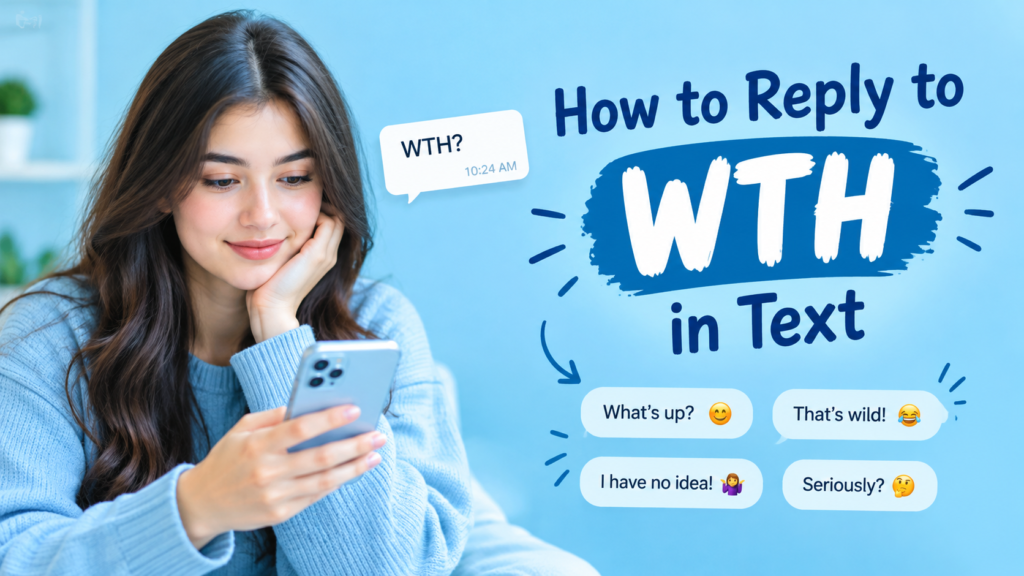
Your reply depends on the mood behind the message. First, read the tone. Then choose a response that fits.
If the person is confused:
- “Sorry, let me explain.”
- “Here is what happened.”
If the person is upset:
- “I understand why you’re annoyed.”
- “Let’s talk about it.”
If the person is joking:
- “Right? 😂”
- “I know, it’s wild.”
If the person is shocked by good news:
- “I know! I can’t believe it either!”
Here are a few tips:
- Stay calm, even if the message feels sharp.
- Ask a question if you do not understand.
- Use a friendly emoji if the chat is playful.
- Call the person if the topic is serious.
A quick, kind reply can stop a small misunderstanding from growing.
Advanced Usage Insights
Once you know the basics, you can use WTH with more skill. Small changes in style send different signals.
- Stretching letters: “wthhhh” shows long, dramatic frustration.
- Adding emojis: “wth 😭” shows playful pain, while “wth 😤” shows anger.
- Using punctuation: “wth…” feels slow and unsure.
- Pairing with words: “wth is this” or “wth happened” adds a clear question.
- Using it as a joke: many people say “wth” ironically with no real emotion.
Another trend is using WTH as a flexible phrase. You might see “the wth moment” or “a total wth situation.” People turn it into a label for odd events.
Also keep in mind that language changes fast. Gen Z often mixes WTH with newer slang. Older users may type it with full punctuation. Both are fine. What matters is that the other person gets your tone.
Why WTH Is Still Popular
WTH has lasted over two decades. That is a long time for slang. There are a few clear reasons.
First, it is useful. People always need a way to say “I can’t believe this.” Few phrases do that as fast.
Second, it is flexible. It works for jokes, complaints, and real shock. It fits many moods and many chats.
Third, it is safe. It is clean enough for most family settings. That gives it a wide reach across age groups.
Finally, it keeps adapting. Each new generation adds its own style, from emojis to memes. That keeps WTH fresh in 2026 and likely beyond.
Frequently Asked Questions
What does WTH mean in a text message?
WTH means “what the heck” or “what the hell.” People use it to show surprise, confusion, or mild frustration.
Is WTH a bad word?
No, WTH is not a bad word. It is a mild, softer version of WTF, though the “hell” version may feel stronger to some people.
What is the difference between WTH and WTF?
WTH means “what the heck” and is mild. WTF uses a harsh curse word and is much stronger.
Can I use WTH at work?
Only in casual chats with coworkers you know well. In emails or messages to bosses and clients, use full words instead.
How do I reply when someone texts me WTH?
Read the tone first, then reply with a calm answer or a short explanation. If you are unsure what they mean, ask a simple question like “What’s wrong?”
Final Thoughts
WTH means “what the heck” or “what the hell.” It is a quick way to show surprise, confusion, or mild annoyance. You can see it in school chats, group threads, and social media comments across the United States. In areas like tax, medicine, schedules, and accounting, it has no official meaning, so context and clear writing matter.
Use WTH with friends and in casual settings. Skip it in formal emails and serious talks. Watch your tone, add context when needed, and read the room before you reply. Do that, and this little abbreviation will help your messages feel natural and clear.

Noah is a passionate content writer and language enthusiast who enjoys making difficult words, phrases, and text meanings easy to understand. He creates clear, simple, and useful articles with practical examples to help readers improve their vocabulary and everyday language skills.